
Selling gold in Tanzania — markets, royalties, the Bank of Tanzania and the 20% rule
A gold sale is a legal event. Weight, purity, an official buyer and a paper trail matter as much as the metal itself.

Gold in a pan or a bar feels like the end of the work. It is not. Until that metal is weighed, assayed and sold at a lawful counter, it is still a risk: a disputed weight, an unexplained cut, or a trade the law does not recognise.
This explainer is general information for small-scale miners, PML holders, licensed dealers, investors, students and partners. It is not a price list, a tax invoice, a trading licence or legal advice. Official prices change; fees and procedures are set by the Mining Commission and the law in force on the day you sell. Check both before you travel.
What you will be able to do
After this explainer you should be able to:
- Explain why a gold sale in Tanzania is a legal event, not a handshake at the shaft.
- Name the lawful places to sell gold, and why trading outside official mineral markets or designated buying stations is an offence under the 2019 Regulations.
- Tell the difference between the Mining Commission’s world, mineral-market and buying-centre price series, and use them as context rather than as automatic offers.
- Distinguish gross weight from fine gold, and show how royalty on gross value (ordinarily 6%, or 4% when gold is sold to the Bank of Tanzania or at a refinery centre), the inspection fee and the 0.1% HIV Response Levy appear as separate lines.
- State the 20% domestic set-aside rule, and list what belongs in a sale file.
First principles: a sale is more than a payment
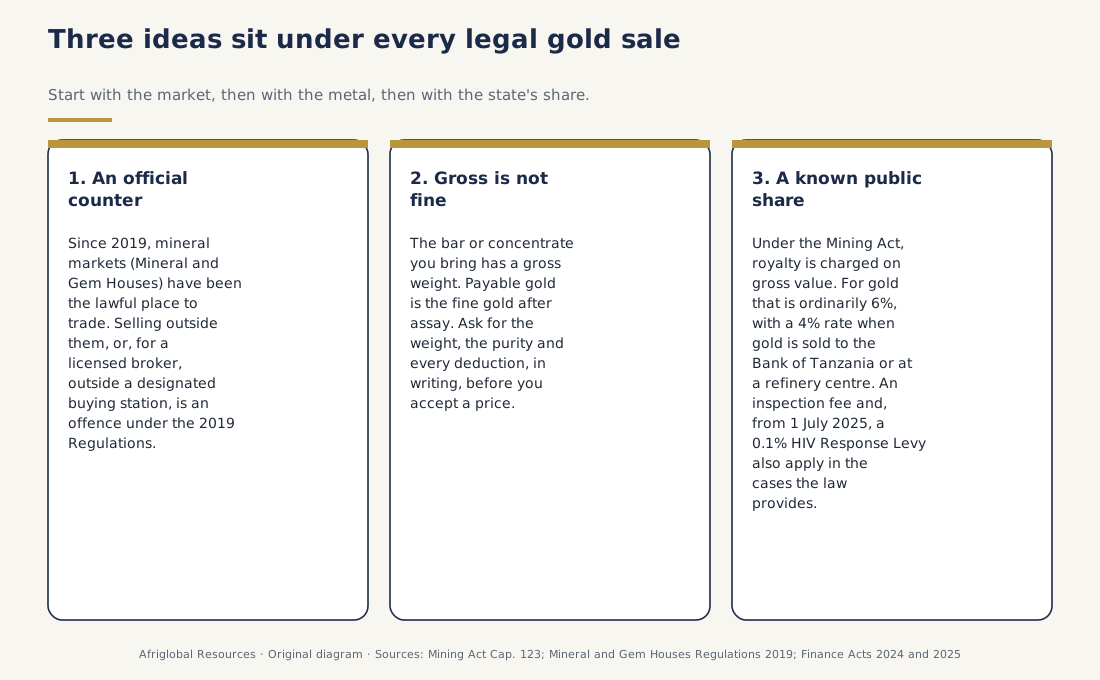
Forget the photograph of a gold room for a moment. Start with three facts.
First, the state has already chosen the counters. Since March 2019, mineral markets — Mineral and Gem Houses — have been the lawful place to trade. The Mineral and Gem Houses Regulations 2019 (GN 418) make trading outside them, or, for a licensed broker, outside a designated buying station, an offence.
Second, the metal you carry has a gross weight. The gold you are paid for is the fine gold after assay. Those are different numbers. A single unexplained “cut” hides that difference.
Third, the public already has a known share. Under the Mining Act, royalty is charged on gross value. For gold that is ordinarily 6%, with a 4% rate when gold is sold to the Bank of Tanzania or at a refinery centre. An inspection fee of 1% of gross value also applies in the ordinary case, with an exemption the Finance Act 2024 provided for gold sold to the Bank. From 1 July 2025, a 0.1% HIV Response Levy on gross value is payable with royalty in the cases the law provides.
A picture to keep
Selling gold at an unnamed stall is closer to cashing a cheque with no bank, no name and no receipt. The metal may be real. The sale may still be worthless — or worse, unlawful — when you need to prove it.
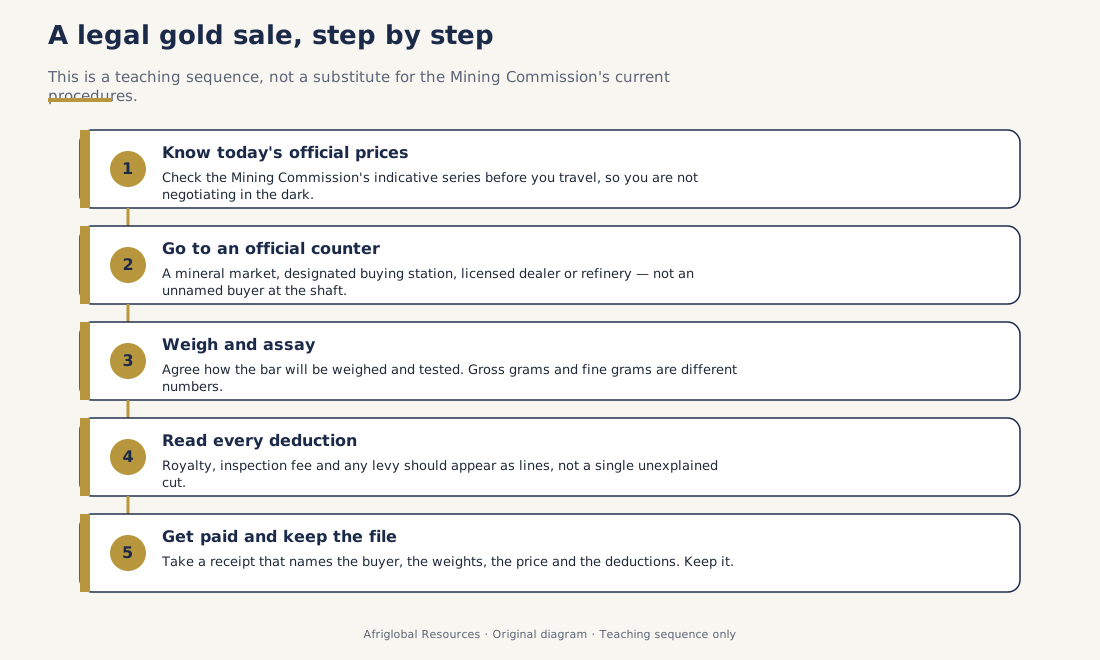
1. Go to an official counter
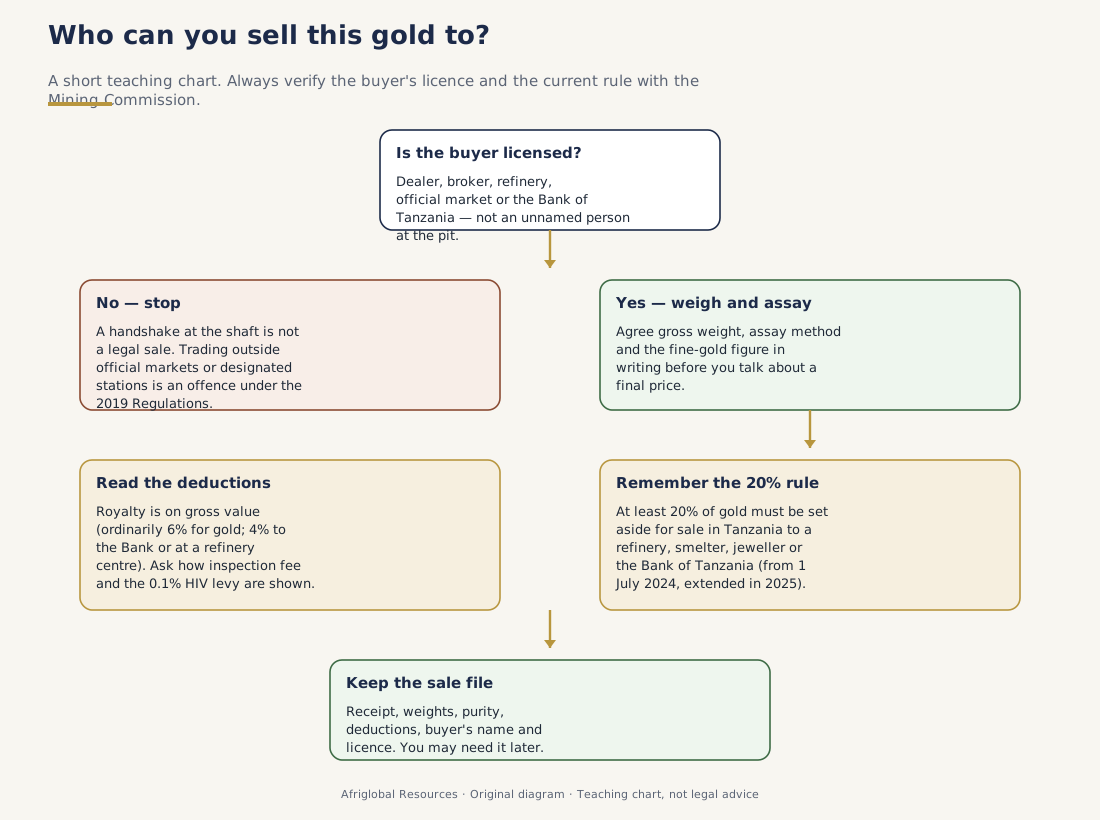
The legal path is short and strict. You sell through a mineral market, a designated buying station, a licensed dealer or broker, a licensed refinery, or — where the Bank’s programme applies — the Bank of Tanzania. You do not sell to an unnamed person at the pit head.
That rule is not a courtesy. It is how the Commission can see the trade, how royalties can be assessed, and how you can later show that the gold was yours to sell. If someone offers a higher price “off the book,” the extra is often the cost of a missing file — and of an offence.
2. Three official price series — and why they are not the same number
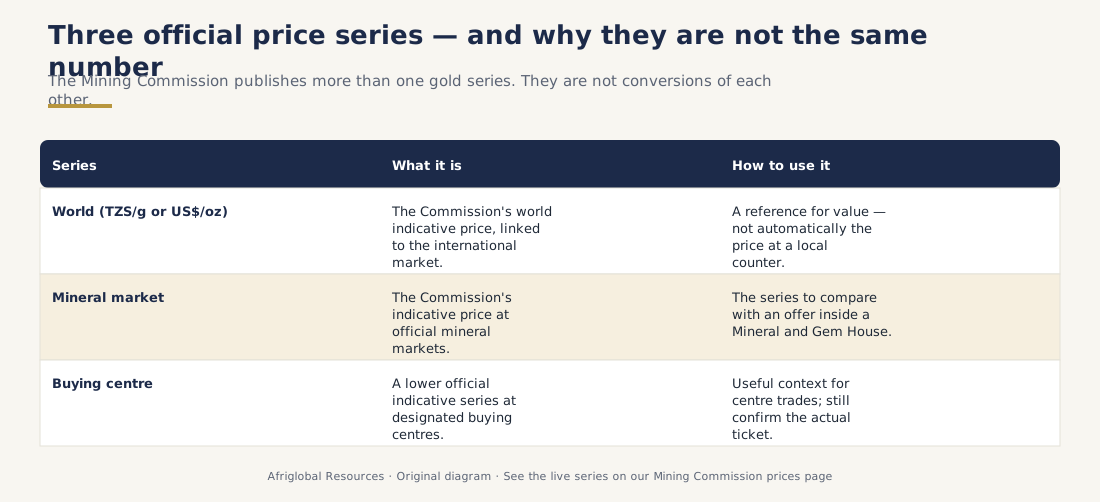
The Mining Commission publishes more than one gold series. They are not conversions of each other. The world indicative price is linked to the international market. The mineral-market series is the Commission’s indicative price at official mineral markets. The buying-centre series is a lower official indicative series at designated buying centres.
Use them as context, not as a promise that a particular window will pay that exact figure today. Compare an offer with the series that matches the counter you are standing at, and still read the ticket. Our Mining Commission prices page shows the live series and explains that they are separate publications.
Go deeper
A world price in US dollars per ounce is a reference for value. It is not automatically the shilling price at a local counter, and it is not a substitute for the assay. If someone “converts” one series into another for you without showing the published numbers, ask to see the Commission’s own figures.
3. Gross weight is not fine gold
Agree, in writing, how the bar or concentrate will be weighed and how it will be assayed, before you talk about a final price. Ask for the gross grams, the purity, and the fine-gold figure. If moisture, slag or wrapping is deducted, that deduction should have a name and a number.
Payable gold is the fine gold. An attractive “price per gram” on the gross weight can hide a weaker assay. The habit that protects you is simple: no ticket, no deal.
4. The state’s share: royalty, inspection fee and the HIV levy
Royalty on gold is charged on gross value under the Mining Act, Cap. 123 (s.111 in the 2023 revised edition). The ordinary rate for gold and other metallic minerals is 6%. A 4% rate applies when gold is sold to the Bank of Tanzania (Finance Act 2024) or at a refinery centre (already provided for in s.111). The inspection fee is 1% of gross value (s.115), with the Finance Act 2024 exemption for gold sold to the Bank. The HIV Response Levy of 0.1% of gross value, introduced by the Finance Act 2025 as a new s.113A, is payable with royalty from 1 July 2025 in the cases the law provides.
The Finance Act 2024 also provided for VAT zero-rating of gold sold to the Bank of Tanzania and to licensed Mainland refineries. Confirm the current VAT treatment with the Tanzania Revenue Authority and the buyer on the day, rather than assuming a past announcement still appears on your ticket in the same way.
Ask the buyer to show each of these as a line, not as a single unexplained cut. This article does not invent official fee schedules or handling charges beyond the rates the Act itself states. For any other deduction, ask what law or published tariff it rests on.
These numbers are assumed so you can follow the arithmetic. They are not today’s official price, not an assay from Kitete or Umoja, and not a tax invoice.
Suppose a miner sells a small bar whose fine gold is 100 grams, and suppose the official gross value used for the illustration is TZS 300,000 per gram — a teaching number only.
Illustrative gross value = 100 × 300,000 = TZS 30,000,000.
Ordinary royalty at 6% = TZS 1,800,000. If the same gold were sold to the Bank of Tanzania or at a refinery centre, royalty at 4% = TZS 1,200,000.
Inspection fee at 1% = TZS 300,000 in the ordinary case; the Finance Act 2024 exemption applies when gold is sold to the Bank.
HIV Response Levy at 0.1% = TZS 30,000, from 1 July 2025, in the cases the law provides.
The lesson is not “this is what you will pay today.” The lesson is that each charge has a name, a rate and a base (gross value). If a buyer shows only one unexplained number, you cannot tell royalty from a private cut. Check the day’s Commission prices on our prices page before you travel, and compare the ticket with the law, not with a rumour.
5. The 20% domestic set-aside
From 1 July 2024, at least 20% of gold must be set aside for sale in Tanzania to a refinery, a smelter, a jeweller or the Bank of Tanzania (Finance Act 2024, amending the Mining Act). The Finance Act 2025 extended this duty to all mineral right holders and dealers.
The rule is about offtake, not about hiding gold. It is one reason formal records and a known buyer matter as much for a small PML as for a larger plant. Plan the sale so that the domestic share is a decision you can show, not a surprise at the door.
6. The Bank of Tanzania and local refineries
The Bank of Tanzania’s Domestic Gold Purchase Program has published delivery points that include Geita Gold Refinery, Mwanza Precious Metals Refinery and Eyes of Africa (Bank notice of 8 October 2024). Mwanza Precious Metals Refinery says it can refine 480 kg of gold a day to 999.9 purity. Those names are useful context for where official offtake can happen; they are not a walk-in promise. Procedures, hours and eligibility are set by the Bank and the refineries, and should be confirmed with them.
For how doré becomes a refined bar, see our explainer on how gold goes from ore to bar in Tanzania.
What this means
- For small-scale miners and PML holders: sell only at a lawful counter, agree weights and assay in writing, read every deduction, and keep the receipt. Check today’s Commission prices before you travel.
- For investors: royalties, the inspection fee, the HIV levy and the 20% domestic set-aside are part of the value chain, not footnotes. Plan offtake around official markets, refineries and, where it applies, the Bank of Tanzania.
- For students and the public: a gold sale has a market, a metal (gross versus fine) and a known public share. The ticket should show all three.
Quick tip: take the day’s prices with you from our Mining Commission prices page, and read them next to the buyer’s ticket, not instead of it.
Common mistakes
- Selling at the shaft or to an unnamed buyer. A handshake is not a legal sale. Trading outside official markets or designated stations is an offence under the 2019 Regulations.
- Accepting a price on gross weight only, without an assay or a fine-gold figure in writing.
- Treating one Commission series as if it were another, or assuming the world price is what a local counter must pay.
- Allowing a single unexplained “cut” to stand in for royalty, inspection fee, levy and private charges.
- Forgetting the 20% domestic set-aside, or assuming it applies only to large mines.
- Leaving the market without a file: receipt, weights, purity, deductions, buyer’s name and licence number.
Lawful selling, in brief
Verify the buyer. Ask for the licence or the official market identity. If you cannot name the buyer on a receipt, do not sell.
Do not invent a fee. The royalty, inspection and levy rates above come from the Mining Act and the Finance Acts of 2024 and 2025. Any other deduction should be explained. This article is not a fee schedule.
This is not tax or legal advice. Rules and published procedures change. Confirm the current position with the Mining Commission, the Tanzania Revenue Authority and the buyer before you complete a sale.
Key takeaways
- A gold sale is a legal event: official counter, agreed weights and assay, and a receipt.
- Since 2019, trading outside mineral markets or, for licensed brokers, outside designated buying stations is an offence (GN 418).
- The Commission’s world, mineral-market and buying-centre series are not conversions of each other. Use them as context, and still read the ticket.
- Royalty is on gross value: ordinarily 6% for gold, 4% to the Bank of Tanzania or at a refinery centre. Inspection fee 1% (with the BoT exemption); HIV Response Levy 0.1% from 1 July 2025 in the cases the law provides.
- From 1 July 2024, at least 20% of gold must be set aside for sale in Tanzania to a refinery, smelter, jeweller or the Bank; the Finance Act 2025 extended this to all mineral right holders and dealers.
Glossary
| English | Kiswahili | In this article |
|---|---|---|
| Mineral market (Mineral and Gem House) | Soko la madini (Nyumba ya Madini na Vito) | The official place, since 2019, where minerals are to be traded. |
| Buying station / buying centre | Kituo cha ununuzi | A designated official counter; licensed brokers must trade at designated stations. |
| Licensed dealer or broker | Muuzaji au dalali mwenye leseni | A person or company authorised to buy and sell minerals. |
| Gross weight | Uzito ghafi | The weighed mass of the bar or concentrate before purity is applied. |
| Fine gold | Dhahabu safi | The payable gold after assay; not the same number as gross weight. |
| Gross value | Thamani ghafi | The value on which royalty and related statutory charges are assessed. |
| Royalty | Mrabaha | The state’s share under the Mining Act; ordinarily 6% of gross value for gold, 4% in the cases above. |
| Inspection fee | Ada ya ukaguzi | A statutory 1% of gross value (s.115), with an exemption for gold sold to the Bank of Tanzania. |
| HIV Response Levy | Tozo ya UKIMWI | 0.1% of gross value from 1 July 2025, payable with royalty in the cases the law provides. |
| 20% rule (domestic set-aside) | Kanuni ya asilimia 20 | At least 20% of gold set aside for sale in Tanzania to a refinery, smelter, jeweller or the Bank. |
| Domestic Gold Purchase Program | Mpango wa Benki Kuu wa kununua dhahabu nchini | The Bank of Tanzania’s programme for buying gold at published delivery points. |
| Doré | Doré | A partly impure gold–silver bar, later refined to bullion. |
Check what you have learned
Five questions. Choose one answer each, then check. This is a self-test, not a certificate.
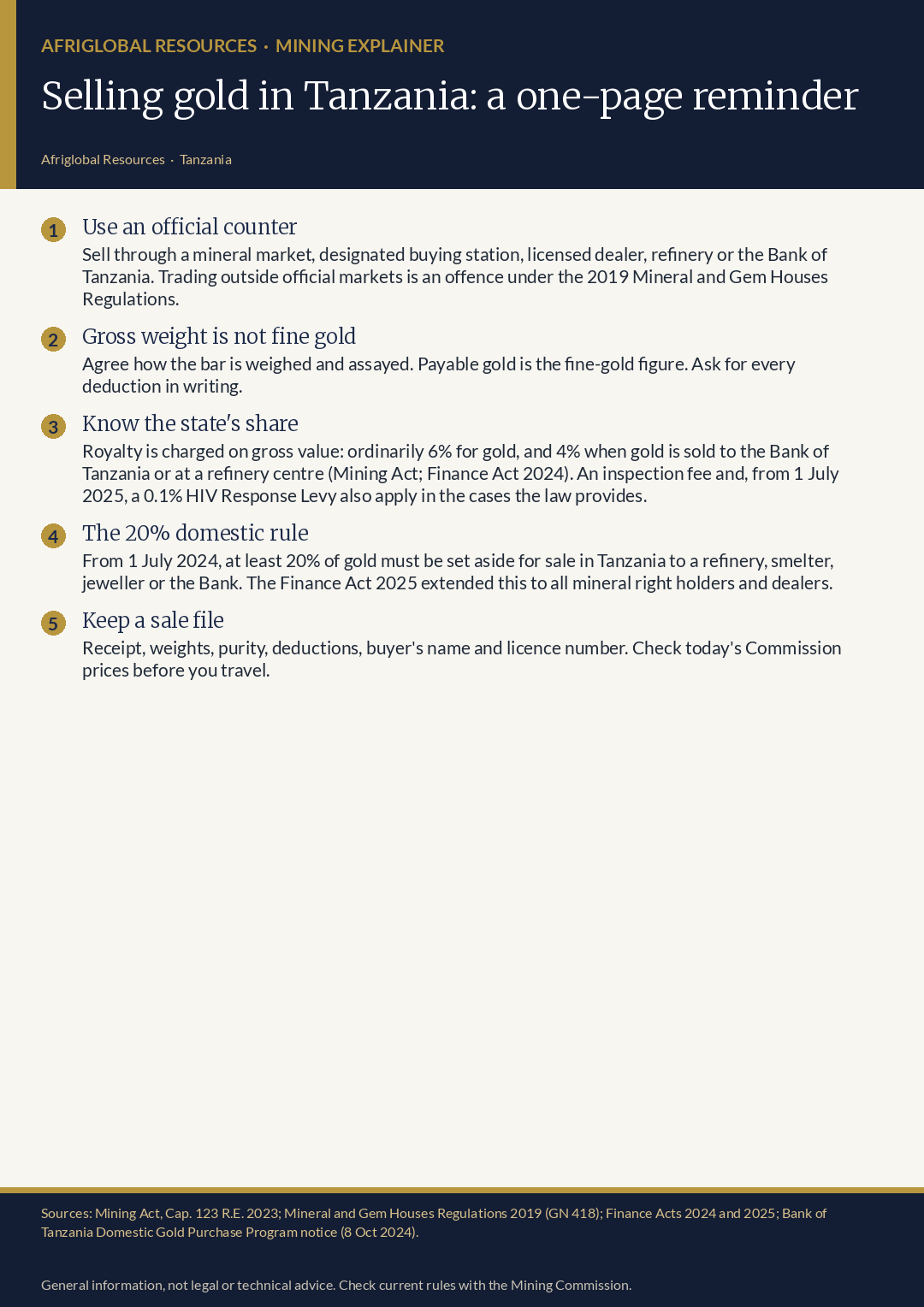
One-page summary
A single printable sheet: official counters, gross versus fine gold, the state’s share, the 20% rule and the sale file. Useful for a classroom, a site office or a briefing pack.
Looking ahead in Tanzania
The direction of travel is already written into law. Gold is to be sold in the open, at official counters, with a file that can be read later. The 20% domestic set-aside, local refineries and the Bank of Tanzania’s purchase programme all point the same way: more of the value of Tanzanian gold should be realised in Tanzania, on a ticket, not in a rumour. The miners and buyers who insist on weights, assays and named deductions will take home both metal and proof.
That is also how a formal, mercury-free, data-driven small-scale sector gets paid. A clean circuit is only half the story if the sale itself cannot be shown.
Afriglobal Resources in Chunya
The Primary Mining Licences (PMLs) are held by the registered licence holder, Mr Yusuf Hassan Mohamed. Afriglobal holds technical-support rights over 18 PMLs under the Technical Support Agreement of 13 November 2025 and its addenda of 19 June and 30 September 2026. Technical support on 10 PMLs is authorised by the Mining Commission (MC/TSA/121-2026); authorisation for the other 8 is being sought. Licence copies are on file for 15 PMLs.
Proposed first-phase expansion: development of the Kitete mine and a proposed 200 TPD CIP processing plant at Umoja (Makongorosi). This is a proposal, not current capacity; it is subject to financing, an independent Competent Person review, exploration drilling, assays and QA/QC (all still to be completed), and approvals. Project financing for this phase is being sought. There is an existing vat-leach facility at Umoja (Makongorosi). No grade or Mineral Resource has been declared.
When gold is sold, it should be sold lawfully — through official markets, licensed buyers, refineries or the Bank — with the 20% domestic rule in view. Read more on our projects page, or our explainers on processing gold from ore to bar, how to apply for and keep a PML and mining licences in Tanzania. Contact us to arrange a site visit.
Kwa Kiswahili (makala kamili)
Toleo kamili la makala hii — si muhtasari tu — lipo kwa Kiswahili: Kuuzia dhahabu Tanzania — masoko, mrabaha, Benki Kuu na kanuni ya asilimia 20.
Sources: The Mining Act, Cap. 123 R.E. 2023 (royalty on gross value, s.111; inspection fee, s.115); Mineral and Gem Houses Regulations 2019 (GN 418); Bank of Tanzania, Domestic Gold Purchase Program notice (8 Oct 2024); Finance Act 2024 (4% royalty and inspection-fee exemption for gold sold to the Bank of Tanzania; VAT zero-rating for gold sold to the Bank and licensed Mainland refineries; 20% domestic set-aside); Finance Act 2025 summary by Rex Attorneys (extension of the 20% rule; HIV Response Levy 0.1% from 1 July 2025, new s.113A); Mining (Minerals and Mineral Concentrates Trading) (Amendment) Regulations 2024; Mwanza Precious Metals Refinery. Live Commission series: our Mining Commission prices page. Site facts about the PMLs, the Technical Support Agreement, the Umoja vat-leach facility and the proposed 200 TPD CIP plant are as stated on our projects page. This article is general information, not legal, tax or trading advice; check current rules and procedures with the Mining Commission, the Tanzania Revenue Authority, the Bank of Tanzania and the buyer. The worked example uses assumed numbers only.
Questions about investing in Tanzanian gold?
Talk to our team about our projects in Chunya and Handeni, or arrange a site visit.