
CIP vs vat leaching in Tanzania — and when gravity is enough
Gold in rock is a few dense particles locked inside ordinary stone. Once you free them, three tools can get them out: density, a carefully managed dissolve-and-collect chemistry, or both. The right route in Tanzania is the one the ore — and the law — will support.

There is no single “best” way to recover gold from rock. In Tanzania, three routes are commonly discussed: gravity concentration, vat leaching and a carbon-in-pulp (CIP) plant. The right choice depends on how the gold is locked in the ore, how much material you will treat, and the approvals, water, power and skills you can support. A headline recovery percentage, or a photograph of someone else’s plant, cannot make that decision on its own.
This explainer is general information for miners, investors, students and partners. It is not a plant design, a feasibility study or technical advice. Recovery always depends on the ore and on how a circuit is built and run.
What you will be able to do
After this explainer you should be able to:
- Explain, from first principles, why gold can be concentrated by density, dissolved with cyanide and oxygen, and collected on activated carbon.
- Describe gravity concentration, vat leaching and CIP in plain language, and say how they differ from each other and from heap leaching.
- Decide what test work to ask for before choosing a route, and recognise when gravity may be enough.
- Spot common mistakes, and state the main safety and legal constraints on cyanide and mercury in Tanzania.
- Recall that Afriglobal’s 200 tonnes-per-day CIP plant at Umoja is a proposal, not current capacity.
First principles: what gold is doing in the rock
Forget the photograph of a plant for a moment. Start with the metal.
Gold is a dense, stubborn element. Its density is about 19.3 g/cm³ — many times heavier than the quartz and ordinary rock around it — and it does not rust or dissolve in ordinary water. In hard rock it usually sits as tiny native particles locked inside other minerals. Until you break that rock, you cannot sort the gold, dissolve it, or catch it. Crushing and grinding are not bureaucracy. They are how you free the particles.
A useful picture: gold in ore is like a few heavy grains baked into a brick. Shake the brick and nothing happens. Smash it to grit, and you can begin to sort, soak or capture what was hidden.
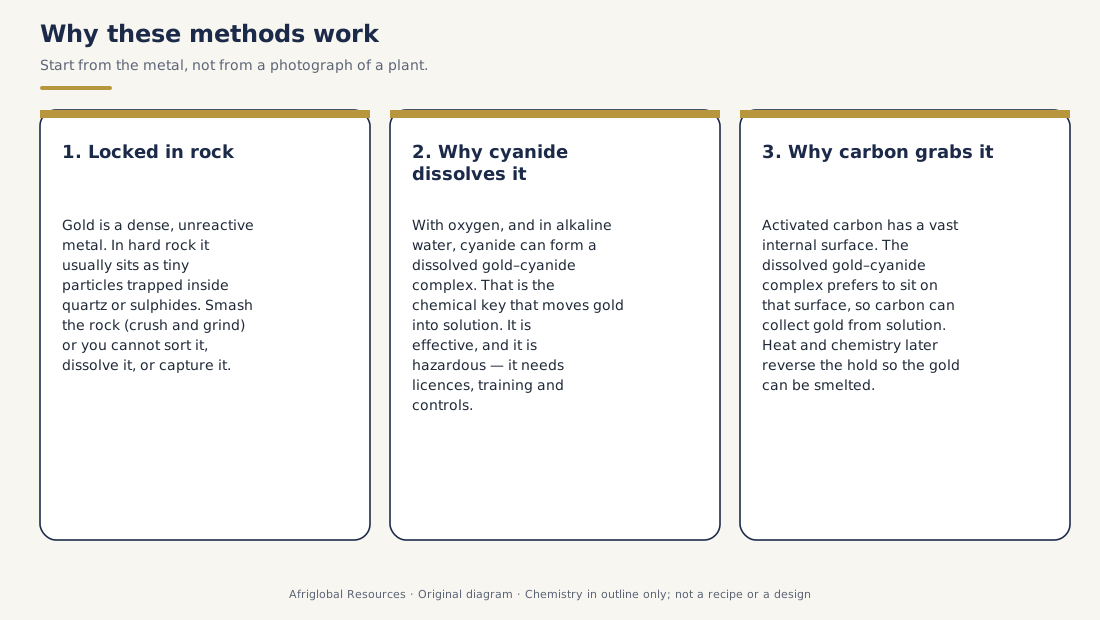
Why can cyanide dissolve gold at all? In alkaline water, and only with oxygen present, cyanide can lock gold into a dissolved gold–cyanide complex and carry it in solution. The US EPA’s technical resource document on gold extraction describes this cyanidation chemistry as the basis of heap, vat-style and agitated (CIP/CIL) recovery. The same chemistry is effective — and hazardous. It is a key, not a household detergent. It needs licences, training and controls, which we return to below.
Why does carbon then grab it? Activated carbon is a sponge with a vast internal surface. The dissolved gold–cyanide complex prefers to sit on that surface, so granules of carbon can collect gold from a lot of slurry or solution. Heat and chemistry later reverse the hold (elution), and electrowinning turns the gold back into metal that can be smelted to doré. That is the dissolve-and-capture idea behind both carbon columns on a vat circuit and the carbon tanks of a CIP plant.
Once those principles are clear, the choice of equipment is a practical one: is the gold already free and coarse enough to fall by density? Or must you dissolve it, and if so, in a still batch (a vat) or in a stirred, continuous line (CIP)?
1. Free the gold first, then choose a recovery route
Gold in hard rock is usually locked inside other minerals. Crushing and grinding free (liberate) the particles so they can be concentrated by density or dissolved in a leach solution. How fine you need to grind is a question for laboratory test work, not a number copied from another mine.
Metallurgists often describe ore as free-milling or refractory. In a widely used SGS technical paper on the process mineralogy of gold ores, free-milling ores are those from which over 90% of the gold can be recovered by conventional cyanide leaching. Refractory ores give low recoveries, or acceptable recoveries only with more complex pre-treatment. If the gold is locked in sulphides or wrapped in other minerals, a gravity table or a vat of cyanide will not, on its own, reach that figure.
2. Gravity concentration: when it can be enough
In brief
Think of a gold pan: heavy metal stays, light rock washes away. When the gold is already free and fairly coarse, a well-run gravity circuit can be enough — and it needs no mercury.
Gold is very dense (about 19.3 g/cm³). Gravity tools — sluices, shaking tables and centrifugal concentrators — use that density to separate gold from lighter rock, without mercury. The UN-led planetGOLD programme promotes these methods for artisanal and small-scale miners.
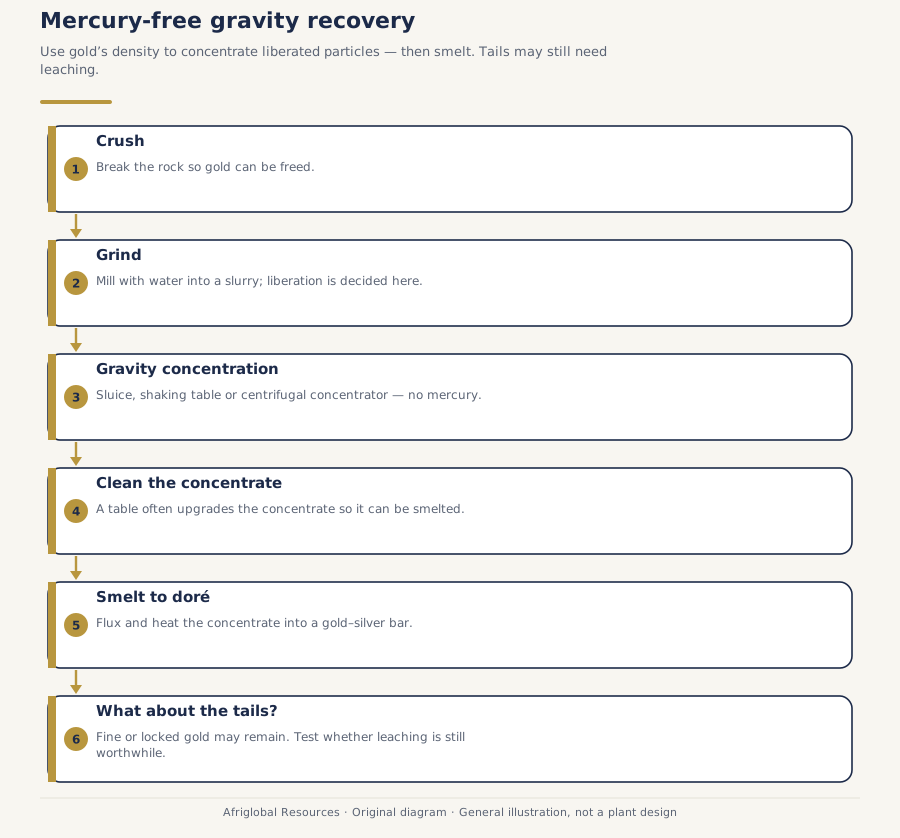
Gravity works best on gold that is liberated and not too fine. planetGOLD notes that recovery becomes less effective when gold particles are very small (less than 0.1 mm), because water can carry fine gold away with the waste. In the planetGOLD Equipment for Responsible Mining booklet, example gravity-concentrator recoveries are given in the region of 70–85% in that booklet’s context. Those results belong to those ores and those plants. They are not a guarantee for Chunya, or for any other site, until the material is tested.
When can gravity be enough? When tests show that most of the valuable gold is coarse and liberated, and the gold left in the tails is not worth the cost and complexity of a leach circuit. Even then, many mines still take a gravity concentrate first and send the tails for leaching, because the two methods catch different gold.
A gravity circuit is also the natural first step in a mercury-free flow: crush, grind, concentrate, clean the concentrate if needed, and smelt. Tanzania ratified the Minamata Convention on Mercury on 5 October 2020, and the Convention entered into force for Tanzania on 3 January 2021. Parties with significant artisanal gold mining must plan to eliminate the worst amalgamation practices, including whole-ore amalgamation and open burning of amalgam.
3. Vat leaching: a batch method, including at Umoja
In brief
Think of steeping tea in a still pot. Solution has to soak through a bed that does not move. That is why percolation, and the time of a batch cycle, matter so much.
Vat leaching is a batch process. Prepared ore or tailings are placed in lined vats. A dilute cyanide solution, kept alkaline with lime, is introduced so that it can percolate through the material and dissolve gold. The gold-bearing (“pregnant”) solution is then typically passed through columns of activated carbon. The loaded carbon is stripped (eluted) and the gold is recovered by electrowinning or a similar step, then smelted to doré.
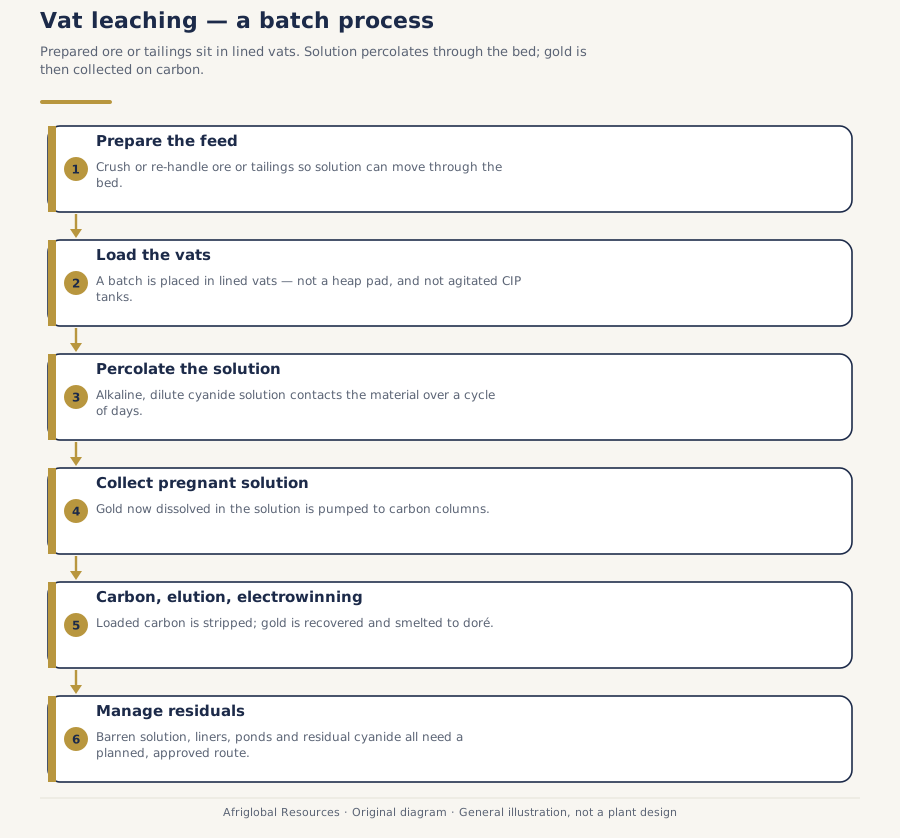
It helps to keep three methods distinct. The US Environmental Protection Agency’s technical resource document on gold extraction and beneficiation describes cyanidation routes that include heap or valley-fill leaching, and agitated carbon-in-pulp or carbon-in-leach circuits, with gold then recovered from activated carbon by elution and electrowinning or zinc precipitation. In everyday Tanzanian use, vat leaching means a contained batch of ore or tailings in vats, not a large outdoor heap and not a continuous CIP plant.
Vats can suit permeable material — including some tailings — and smaller or existing facilities, because the plant is usually simpler than a full agitated CIP circuit. The limits are also clear: if the material is too fine, clay-rich or poorly permeable, solution can channel and leave gold behind; cycles are measured in days rather than hours; and cyanide, liners, solution ponds and residual-cyanide management still have to be designed and approved.
Afriglobal Resources already has an existing vat-leach facility at Umoja (Makongorosi) in Chunya. Stockpiled ore from the Kitete workings is intended to be fed to those vats once the crusher and grinder now being mobilised are in place. The vat-leaching plant holds OSHA workplace registration, and the site holds GCLA registration for chemical storage and use, in the licence holder’s name. NEMC registration of the existing operation was obtained in December 2025; further environmental work for a larger plant is still to follow. See our projects page.
4. CIP: a continuous agitated leach, when the ore and the tonnage support it
In brief
Think of a stirred production line. Gold is dissolved in agitated tanks, then carbon beads — reusable sponges with a vast internal surface — collect it as they move against the slurry flow.
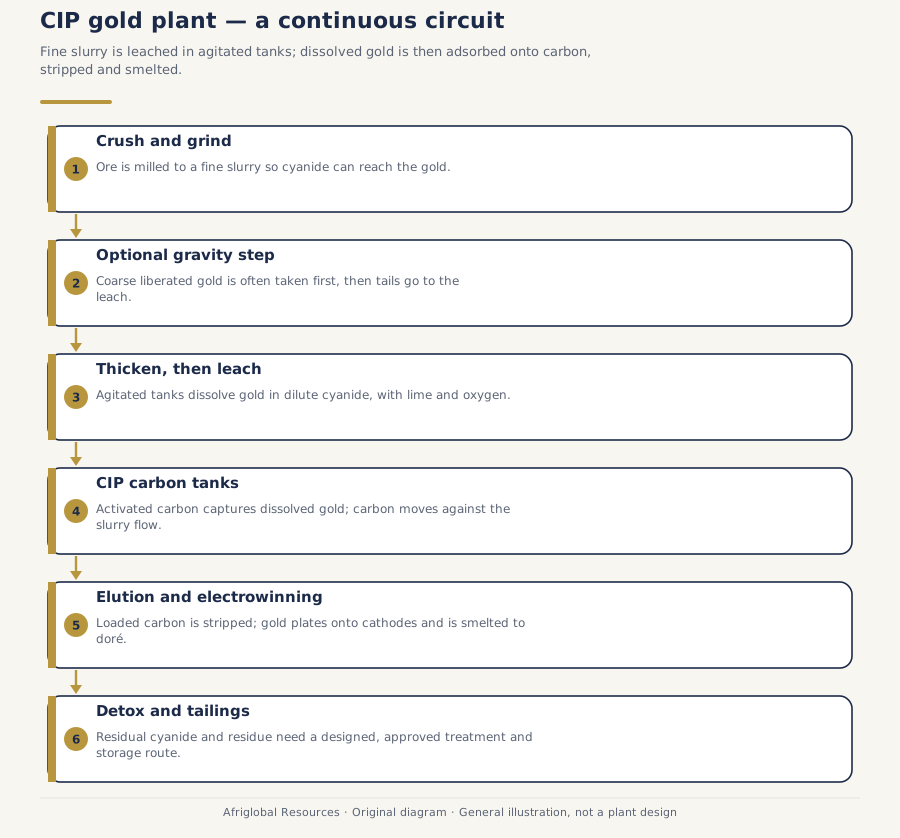
A carbon-in-pulp (CIP) plant is built for gold that is too fine, or insufficiently recovered, for gravity alone. Ore is crushed and milled to a fine slurry. After thickening, gold is dissolved with dilute sodium cyanide in a train of agitated tanks, in the presence of oxygen, at an alkaline pH so that cyanide is not lost as hydrogen cyanide gas. The dissolved gold is then adsorbed onto granules of activated carbon in a separate train of tanks. Loaded carbon is eluted, the gold is electrowon onto cathodes, and the sludge is smelted to doré. Stripped carbon can be regenerated and returned to the circuit. Tailings still contain cyanide and need a planned detoxification and containment route.
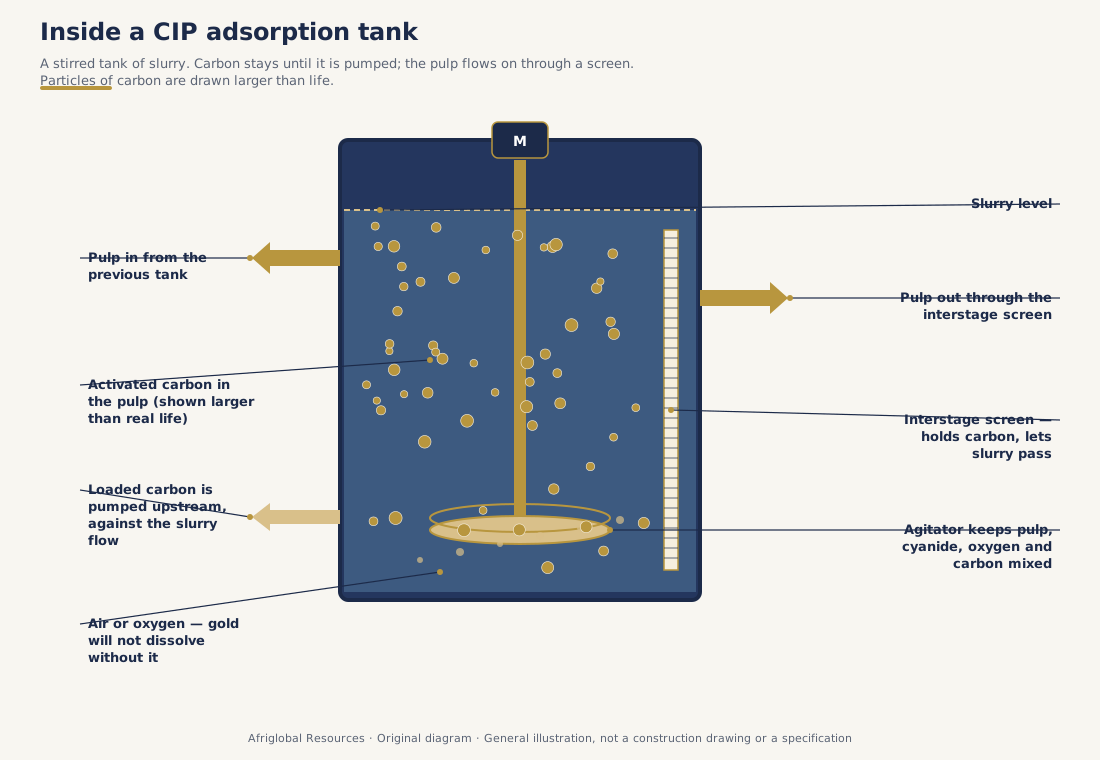
A picture to keep
If vat leaching is steeping tea in a still pot, CIP is a stirred production line. The carbon beads are reusable sponges, moving against the slurry so the richest carbon meets the richest solution.
Going deeper
A 1999 process-design paper in the Journal of the Southern African Institute of Mining and Metallurgy describes conventional CIP practice in some detail, including thickening the pulp (often to around 50% solids), adjusting pH to about 9.5–11, and a cascade of typically six to eight adsorption tanks in which carbon is held by screens and moved counter-current to the slurry. Those figures are from a general design paper. They are not a specification for any Afriglobal plant.
Carbon-in-leach (CIL) is a close variation: carbon is added in the leach tanks so that dissolution and adsorption happen together. CIL can reduce the number of tank trains. It is often considered when the ore is preg-robbing — that is, when carbonaceous material in the ore can steal dissolved gold from solution. The choice between CIP and CIL, like the choice to build either, belongs to test work and a competent designer.
Cyanide is effective, and it is hazardous. The International Cyanide Management Code is a voluntary standard for the safe management of cyanide used to recover gold and silver. It is a useful management reference; it does not replace Tanzanian approvals. In Tanzania, chemical use is regulated (including through the Government Chemist Laboratory Authority, GCLA), and environmental approvals sit with the National Environment Management Council (NEMC) and the requirements of the Mining Commission for the mineral right.
5. Comparing the three routes
The table and diagram below compare typical differences. They do not quote capital costs or promise a recovery percentage. For free-milling ore, conventional cyanide leaching can recover over 90% of the gold — that is how the SGS paper cited above defines the term — but only if the ore really is free-milling and the plant is designed and operated for it. Gravity or vat leaching may recover less, or may recover most of the available gold at lower complexity, depending on particle size and permeability. The only honest comparison is a test programme on your material.
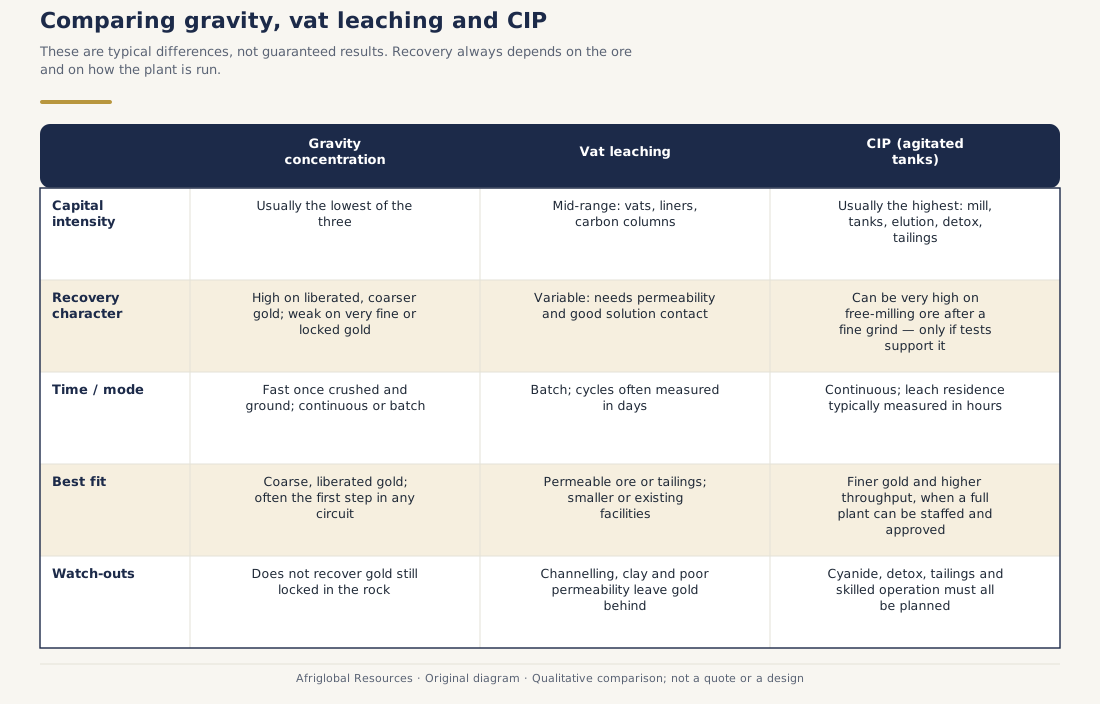
| Question | Gravity concentration | Vat leaching | CIP (agitated tanks) |
|---|---|---|---|
| Capital intensity | Usually the lowest of the three | Mid-range: vats, liners, carbon columns | Usually the highest: mill, tanks, elution, detox, tailings |
| Recovery character | High on liberated, coarser gold; weak on very fine or locked gold | Variable: needs permeability and good solution contact | Can be very high on free-milling ore after a fine grind — only if tests support it |
| Time / mode | Fast once crushed and ground; continuous or batch | Batch; cycles often measured in days | Continuous; leach residence typically measured in hours |
| Best fit | Coarse, liberated gold; often the first step in any circuit | Permeable ore or tailings; smaller or existing facilities | Finer gold and higher throughput, when a full plant can be staffed and approved |
| Watch-outs | Does not recover gold still locked in the rock | Channelling, clay and poor permeability leave gold behind | Cyanide, detox, tailings and skilled operation must all be planned |
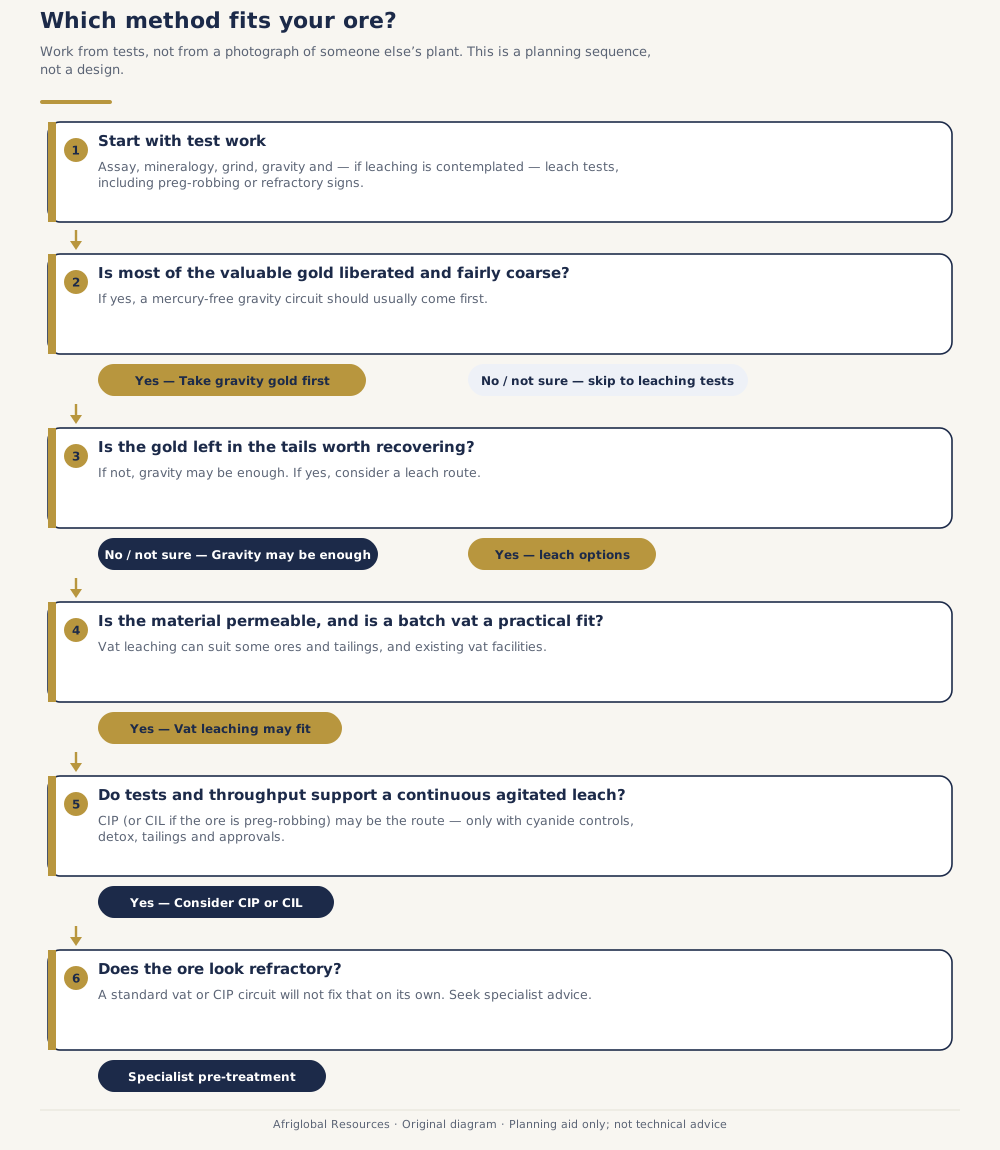
6. Which method fits your ore?
A practical sequence is to test first, take gravity-recoverable gold if the tests support it, then decide whether leftover gold justifies a leach circuit — and, if so, whether a batch vat or a continuous CIP (or CIL) plant is the better fit. Refractory ore is a different problem: a standard vat or CIP circuit will not fix it on its own.
7. A worked example (illustrative numbers only)
These numbers are assumed so you can follow the arithmetic. They are not assays from Kitete or Umoja, and they are not a forecast for the proposed 200 TPD CIP plant.
Suppose a small circuit treats 50 tonnes of ore in a day, at an assumed head grade of 2 grams of gold per tonne.
Gold in that day’s feed = 50 × 2 = 100 g.
Suppose a gravity test on this illustrative ore showed that 40% of the gold is recoverable by gravity (liberated and coarse enough). Gravity product = 40 g. Gold remaining in the tails = 60 g.
Suppose a cyanide leach test then recovered 90% of the gold left in those tails. That kind of result is only realistic if the remaining gold is free-milling in the SGS sense, and if the plant is designed and run for it. Leach product = 0.90 × 60 = 54 g.
Combined recovery in the example = 40 + 54 = 94 g out of 100 g in the feed.
The arithmetic is there to make a choice visible, not to promise a yield. If you stop after gravity, you leave the 60 g in the tails. If you skip gravity, a leach may still recover a high share of free-milling gold, but you send coarse gold through a more complex circuit. If the leach test had failed, neither a vat nor a CIP plant would have produced that 54 g.
Time and throughput differ too. An illustrative vat that holds 80 tonnes on a 5-day cycle (load, leach, drain, unload — assumed) treats 80 ÷ 5 = 16 tonnes per day per vat. A continuous CIP plant sized for 50 tonnes per day treats that every day it is running — but only if the mill, tanks, elution, detox and tailings route are all in service. More tonnes per day is not automatically more profit.
Common mistakes
- Copying someone else’s recovery or tank size. Free-milling ore can yield over 90% by conventional cyanide leaching in the SGS definition — that is a definition, not a guarantee for your rock.
- Assuming a vat will work on a bed that will not let solution through. Clay, fines and channelling leave gold behind.
- Treating gravity and leaching as rivals rather than partners. They often catch different gold.
- Using mercury, or leaching material that still contains mercury. Tanzania is a party to the Minamata Convention; the worst amalgamation practices are meant to be eliminated, and cyanide must not be used on mercury-bearing material until the mercury has been removed.
- Ordering a CIP plant from a photograph, without test work, cyanide approvals, detox, tailings, power, water and trained operators.
- Reading a proposed plant as current capacity. Afriglobal’s 200 TPD CIP plant at Umoja is a proposal, subject to financing, an independent Competent Person review, drilling, assays, QA/QC and approvals.
Safety and the environment, in brief
Mercury-free first. Gravity concentration needs no mercury. Where it fits the ore, it is the cleanest first step for small-scale miners. See the planetGOLD guides cited below, our full guide to mercury-free gold recovery for small-scale miners, and our explainer on how gold goes from ore to bar.
Cyanide is a controlled chemical, not a shortcut. The International Cyanide Management Code is a voluntary standard for managing cyanide used to recover gold and silver. It is a useful reference; it does not replace Tanzanian law. Chemical use is regulated through the Government Chemist Laboratory Authority (GCLA). Environmental approvals sit with the National Environment Management Council (NEMC) and with the Mining Commission’s requirements for the mineral right. This article does not give doses or recipes.
Residue is part of the process. A leach circuit is unfinished without a planned route for residual cyanide, solution ponds or lined vats, and tailings. If those pieces are missing, the circuit is not ready — however shiny the tanks look.
What this means
- For small-scale miners and PML holders: start with better crushing and mercury-free gravity where the gold is liberated. Do not assume a cyanide vat will pay if the material will not let the solution through, and do not use cyanide without the right licences, training and controls.
- For investors: process choice is part of project risk. Afriglobal’s current processing route at Umoja is vat leaching; a 200 tonnes-per-day CIP plant is a proposal, not current capacity.
- For students and the public: gravity concentrates heavy gold; vats soak a batch; CIP dissolves gold in a continuous tank train and captures it on carbon.
Quick tip: if you sell gold, check the day’s official price on our Mining Commission prices page, and see our explainer on how gold goes from ore to bar in Tanzania.
Key takeaways
- Gold is a dense metal locked in rock. Free it first. Then choose density, a careful dissolve-and-capture step, or both.
- Gravity is mercury-free and can be enough when tests show the valuable gold is liberated and fairly coarse, and the tails are not worth leaching.
- Vat leaching soaks a batch; CIP stirs a continuous slurry and collects gold on carbon. They are not the same as heap leaching, and CIP is not the same as CIL.
- Recovery is not a number you can copy from a brochure. Test work first; cyanide, detox, tailings and approvals are part of any leach plant.
- At Umoja, Afriglobal already has a vat-leach facility. A 200 TPD CIP plant is a proposed first-phase development, not current capacity.
Glossary
| English | Kiswahili | In this article |
|---|---|---|
| Gravity concentration | Utenganishaji kwa uzito | Using density (sluices, tables, centrifugal concentrators) to separate liberated gold, without mercury. |
| Vat leaching | Uchenjuaji kwenye vati | A batch of ore or tailings in lined vats, with solution percolating through the bed. |
| CIP (carbon-in-pulp) | CIP (kaboni katika tope) | Gold is dissolved in stirred tanks, then collected on carbon in a separate tank train. |
| CIL (carbon-in-leach) | CIL (kaboni katika uchenjuaji) | Dissolving and carbon collection happen in the same tanks; often considered for preg-robbing ore. |
| Free-milling ore | Mawe free-milling | Ore from which over 90% of the gold can be recovered by conventional cyanide leaching (SGS definition). |
| Refractory ore | Mawe refractory | Ore that gives low recoveries, or acceptable recoveries only after more complex pre-treatment. |
| Preg-robbing | Preg-robbing | Carbonaceous material in the ore that can steal dissolved gold from solution. |
| Activated carbon | Kaboni iliyohamasishwa | Porous carbon with a large internal surface that adsorbs the dissolved gold–cyanide complex. |
| Elution | Elution (kuvua dhahabu kwenye kaboni) | Stripping loaded carbon so the gold returns to a rich solution, ready for electrowinning. |
| Electrowinning | Electrowinning | Using an electric current to plate gold from solution onto cathodes. |
| Doré | Doré | A partly impure gold–silver bar, smelted on site, later refined to bullion. |
| Tails (tailings) | Taka (za uchenjuaji) | The residue after gold has been recovered — still to be managed, especially after cyanide. |
Check what you have learned
Five questions. Choose one answer each, then check. This is a self-test, not a certificate.
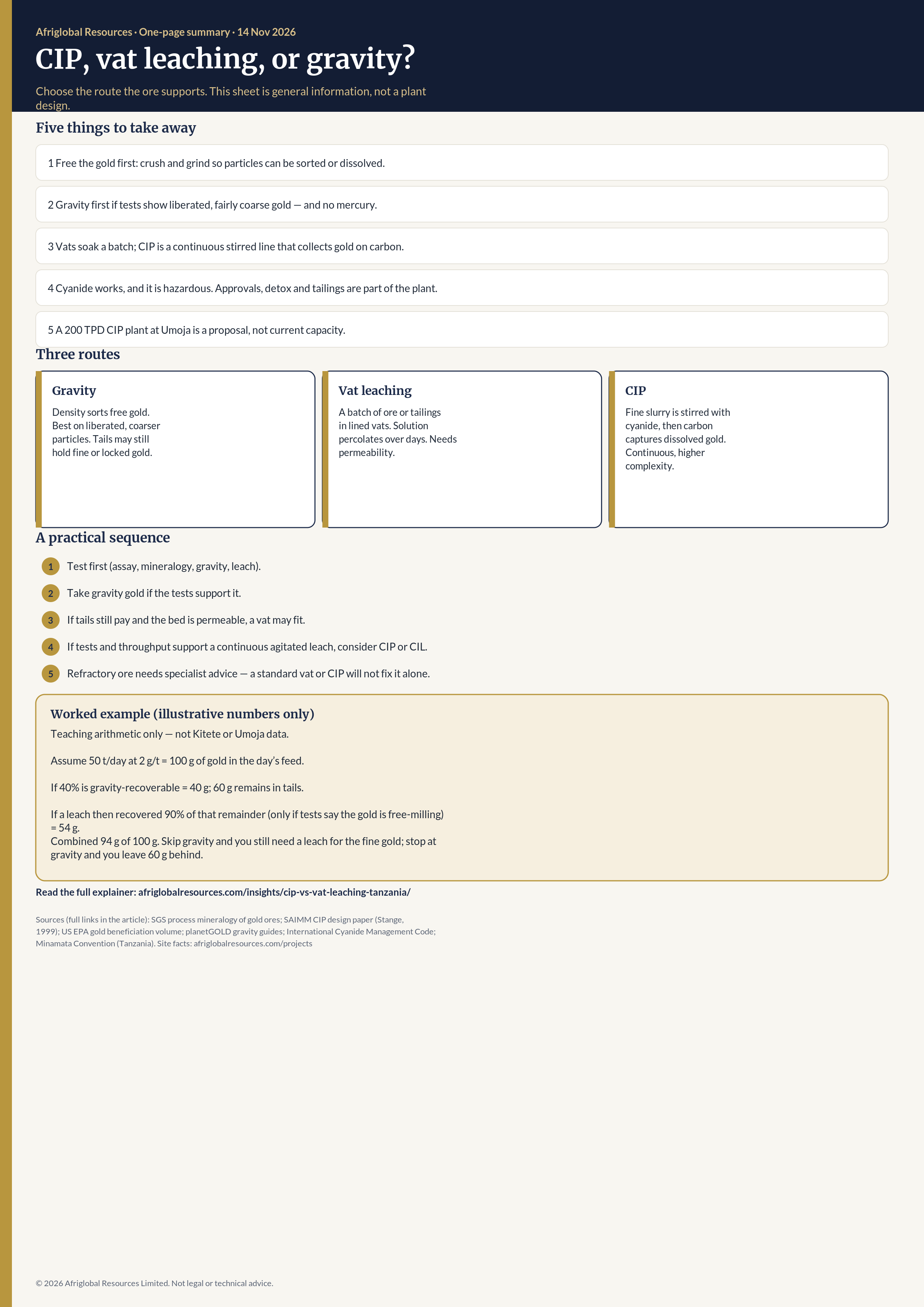
One-page summary
A single printable sheet: the five takeaways, the three routes, the decision sequence and the worked example, with sources. Useful for a classroom, a site office or a briefing pack.
Looking ahead in Tanzania
The direction of travel is already written into law and into good practice. Tanzania is a party to the Minamata Convention: the future of small-scale gold is mercury-free. Gravity circuits, better crushing, and — only where the ore and the licences support it — carefully managed cyanide plants are how that future gets built. The other half of the future is data. A cheap photograph of a plant is not evidence. Assays, mineralogy, gravity tests and leach tests are. The miners and investors who insist on those numbers will waste less money and spill less harm.
That is also how Afriglobal intends to think about Chunya: run the vats that are already there, gather evidence, and treat a CIP plant as something you earn with tests, financing and approvals — not something you announce into existence.
Afriglobal Resources in Chunya
At Kitete, existing underground shafts are the main ore source of the Chunya–Makongorosi project. At Umoja (Makongorosi), there is an existing vat-leach facility and the proposed site of a 200 TPD CIP processing plant: a proposed first-phase development, not current capacity; subject to financing, an independent Competent Person review, exploration drilling, assays and QA/QC (all still to be completed), and approvals. Project financing for this phase is being sought.
Read more on our projects page, or our explainers on processing gold from ore to bar and mining licences in Tanzania. Contact us to arrange a site visit.
Kwa Kiswahili (makala kamili)
Toleo kamili la makala hii — si muhtasari tu — lipo kwa Kiswahili: CIP, uchenjuaji kwenye vati na uzito: ni njia gani inayofaa mawe yako ya dhahabu?
Sources: SGS, Establishing Process Mineralogy of Gold Ores (free-milling defined as over 90% recoverable by conventional cyanide leaching); Stange, “The process design of gold leaching and carbon-in-pulp circuits”, Journal of the SAIMM, 99(1), 1999; US EPA, Technical Resource Document: Extraction and Beneficiation of Ores and Minerals, Volume 2: Gold; planetGOLD, Practical Guide for ASGM: Gravimetric Plants for Mercury-Free Gold Recovery; planetGOLD, Equipment for Responsible Mining (example gravity-concentrator recoveries of 70–85% in that booklet’s context); International Cyanide Management Code; Minamata Convention, United Republic of Tanzania; Minamata Convention text, Annex C. Site facts about Kitete, the Umoja vat-leach facility and the proposed 200 TPD CIP plant are as stated on our projects page. This article is general information, not legal or technical advice; check current rules with the Mining Commission, GCLA and NEMC, and base any plant decision on site-specific test work and approved design.
Questions about investing in Tanzanian gold?
Talk to our team about our projects in Chunya and Handeni, or arrange a site visit.