
Mercury-free gold recovery for small-scale miners in Tanzania
Gold does not need mercury. Mercury alloys with gold — then becomes an invisible vapour and a lasting poison in fish, soil and people. Density can catch the metal; heat can finish a rich concentrate. The law in Tanzania already points this way.

Gold is a dense, stubborn metal locked inside ordinary rock. Mercury is a liquid metal that alloys with it, which is why a few drops can look like a shortcut. That shortcut is a trap. Heat turns mercury into an invisible vapour; in water and soil it becomes a poison that lasts in fish and in people. Tanzania is already a Party to the treaty that says this practice must be reduced and, where feasible, eliminated. Density, careful upgrading and a hot crucible can do the work instead.
This explainer is general information for small-scale miners, PML holders, investors, students and partners. It is not a plant design, a feasibility study, a training certificate or a recipe. It does not tell you how to use mercury, and it does not give cyanide or flux dosages. Recovery always depends on the ore and on how a circuit is built and run.
What you will be able to do
After this explainer you should be able to:
- Explain, from first principles, why mercury amalgamates gold and why that convenience harms health and the environment.
- State Tanzania’s position under the Minamata Convention and name the worst practices the Convention says must be eliminated.
- Describe mercury-free gravity tools — panning, sluices, centrifugal concentrators and shaking tables — and when each is useful.
- Explain what direct smelting with a flux such as borax can and cannot do, and when a licensed cyanidation step might be considered.
- Spot common mistakes, including unsourced “miracle” chemicals and the temptation to leach mercury-bearing tails.
First principles: why mercury seemed to work — and why it must stop
Forget the photograph of a processing yard for a moment. Start with the two metals.
Gold is dense (about 19.3 g/cm³) and does not rust or dissolve in ordinary water. Mercury is unusual in another way: it is a metal that is liquid at ordinary temperatures. It wets gold and alloys with it, forming an amalgam. That is a physical fact, not a blessing. It is why mercury can look, in a pan or a mill, like a convenient way to pick gold out of a pile of sand.
A useful picture: mercury is a sticky liquid magnet for gold. The magnet is poison. When the amalgam is heated, the mercury does not disappear — it becomes an invisible, odourless vapour. The World Health Organization states that inhaling mercury vapour can harm the nervous, digestive and immune systems, the lungs and the kidneys, and may be fatal. Children and pregnant women are especially at risk. WHO briefings on artisanal gold mining also note that vapour around open burning sites often exceeds the WHO public air guideline of 1.0 µg/m³, and that people who are not themselves holding the amalgam can still be exposed.
What is spilled or settled does not stay put. In water and soil, microbes can turn elemental mercury into methylmercury, which builds up in fish and in people who eat them. The United Nations Environment Programme and the Minamata Convention describe artisanal and small-scale gold mining as the largest source of mercury emissions and releases to the environment.
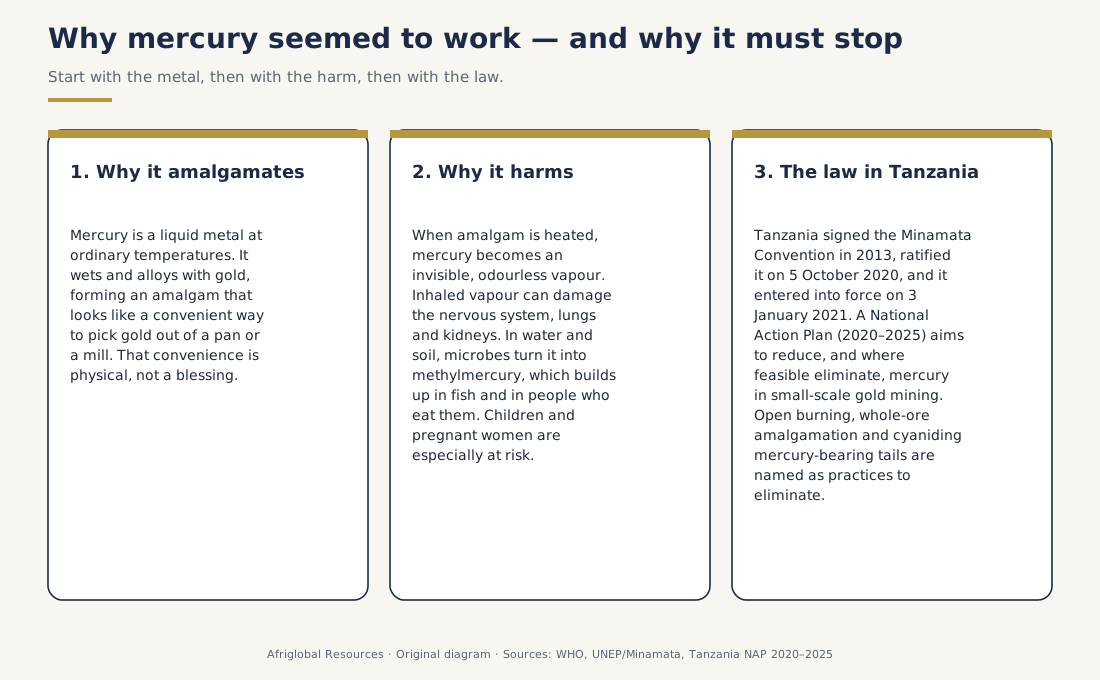
The law points the same way. Tanzania signed the Minamata Convention on 10 October 2013, ratified it on 5 October 2020, and the Convention entered into force for Tanzania on 3 January 2021. Article 7 requires Parties with more than insignificant artisanal and small-scale gold mining to take steps to reduce, and where feasible eliminate, mercury use, and to prepare a National Action Plan. Tanzania’s National Action Plan for Artisanal and Small-Scale Gold Mining, 2020–2025, published by the Vice President’s Office, sets the goal of reducing, and where feasible eliminating, mercury use in ASGM. One stated objective of that plan was to reduce mercury use in the sub-sector by 30% and enhance public awareness by 2025. That is a plan objective, not a claim in this article that the target has been met.
Annex C of the Convention names practices that National Action Plans must aim to eliminate: whole-ore amalgamation (adding mercury to a large mass of ore with little prior concentration); open burning of amalgam or processed amalgam; burning amalgam in residential areas; and cyanide leaching of sediment, ore or tailings to which mercury has been added, without first removing the mercury. Tanzania has also issued the Environmental Management (Control and Management of Mercury and Mercury Compounds) Regulations, 2020. Tanzania’s 2021 report to the Convention records cooperation with the World Bank, among others, on the Environmental Health and Pollution Management Project, which includes promotion of mercury-free alternatives.
A picture to keep
Burning amalgam is not “processing.” It is closer to boiling a poison kettle in the yard — or, worse, in a house or a market. The steam is the danger, and it does not stay in the kettle.
1. Liberate the gold first
Until you break the rock, you cannot sort the gold, smelt it, or dissolve it. Crushing and grinding are how you free the particles. Mixed sizes then fight each other in a pan or a sluice: coarse rocks trap sand, and fine gold is washed away. Classification — sorting by size — is not bureaucracy. It is how gravity is given a fair chance.
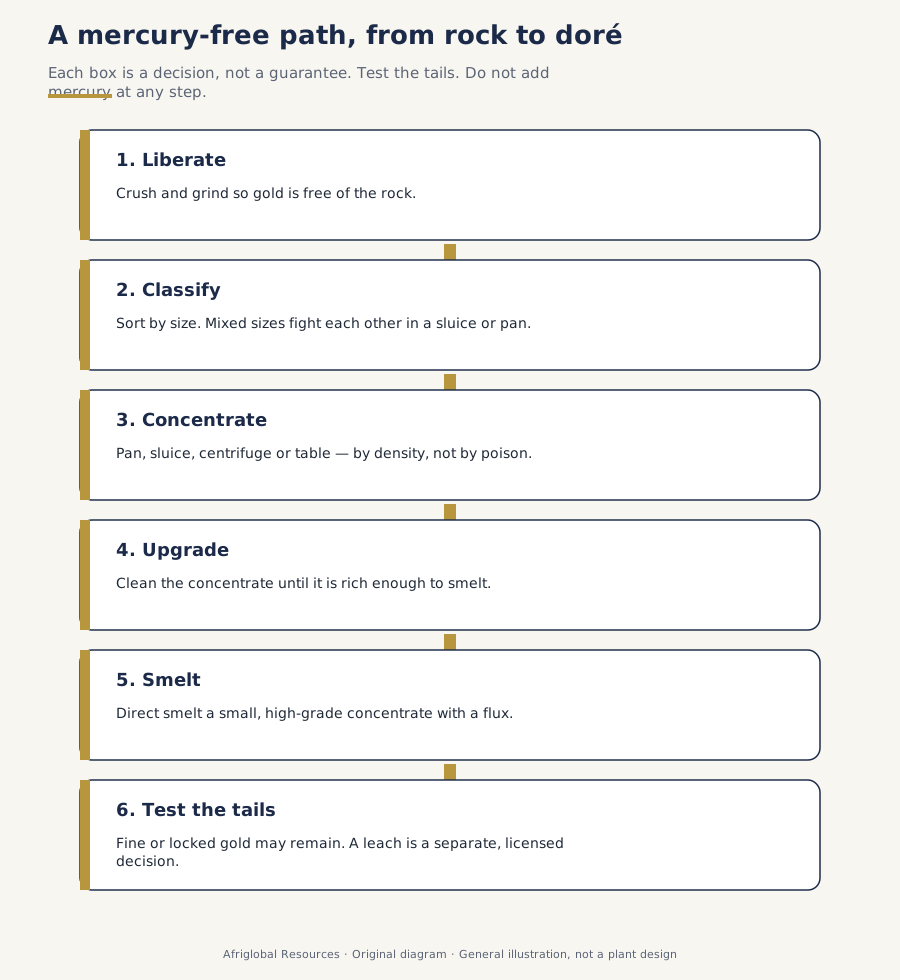
2. Panning, without mercury
In brief
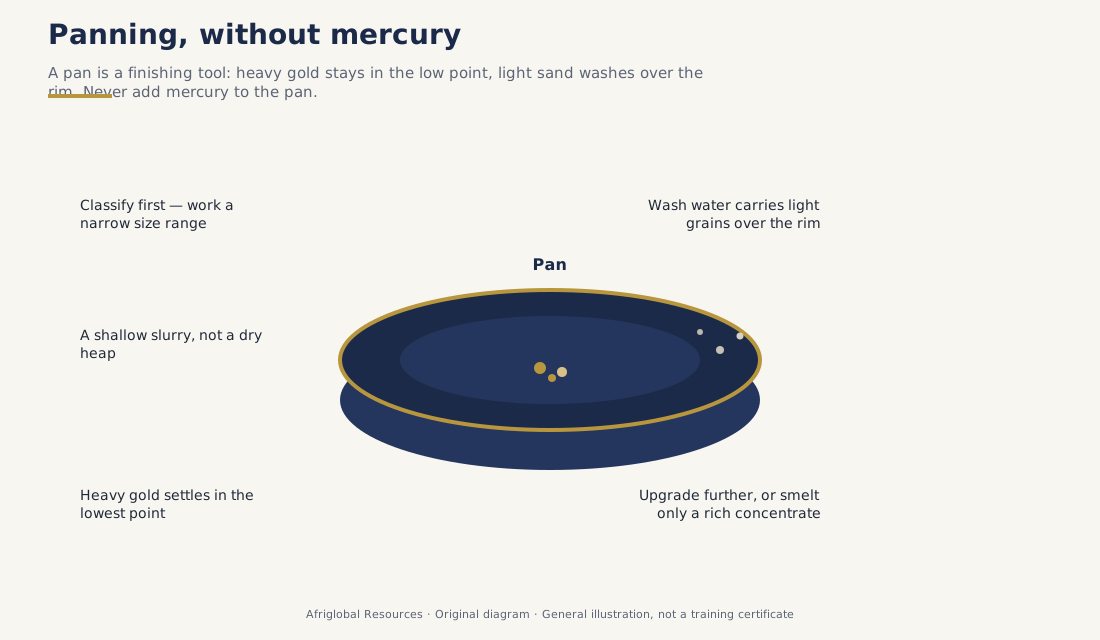
Think of a shallow bowl in a stream: heavy grains stay in the low point, light sand washes over the rim. A pan is a finishing tool, and sometimes a tool for very small batches — not a reason to add mercury.
Good panning starts with classified feed and a shallow slurry, not a dry heap. The motion should keep a pulp moving so light material can leave and gold can settle. Fine gold is easy to wash out if the pan is crowded or the water is wild. The concentrate you keep should be upgraded further, or smelted only when it is already rich. Never add mercury to the pan. That turns a simple gravity step into a health and legal problem.
3. Sluices
In brief
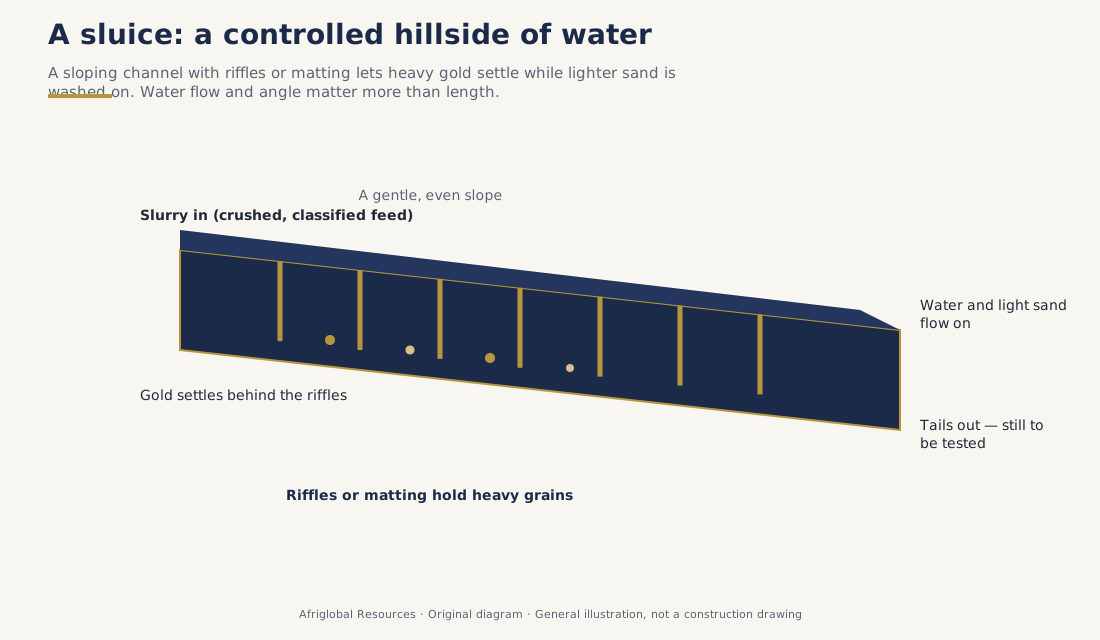
Think of a controlled hillside of water. Riffles or matting give heavy gold a place to settle while sand is washed on. The angle and the water flow matter more than how long the box is.
A sluice is a sloping channel. Crushed, classified slurry is fed at the top. Water carries the stream over riffles or matting; dense gold drops behind those traps; lighter sand continues to the tails. Sluices can be built at modest cost and need no electricity, which is why they are widely used. Their limit is just as important: very fine or still-locked gold is washed on. planetGOLD’s practical guide to mercury-free gravimetric plants notes that gravity recovery becomes less effective when gold particles are smaller than about 0.1 mm, because drag from the water starts to beat settling. The tails of a sluice are not “waste” until someone has tested them.
4. Centrifugal concentrators
In brief
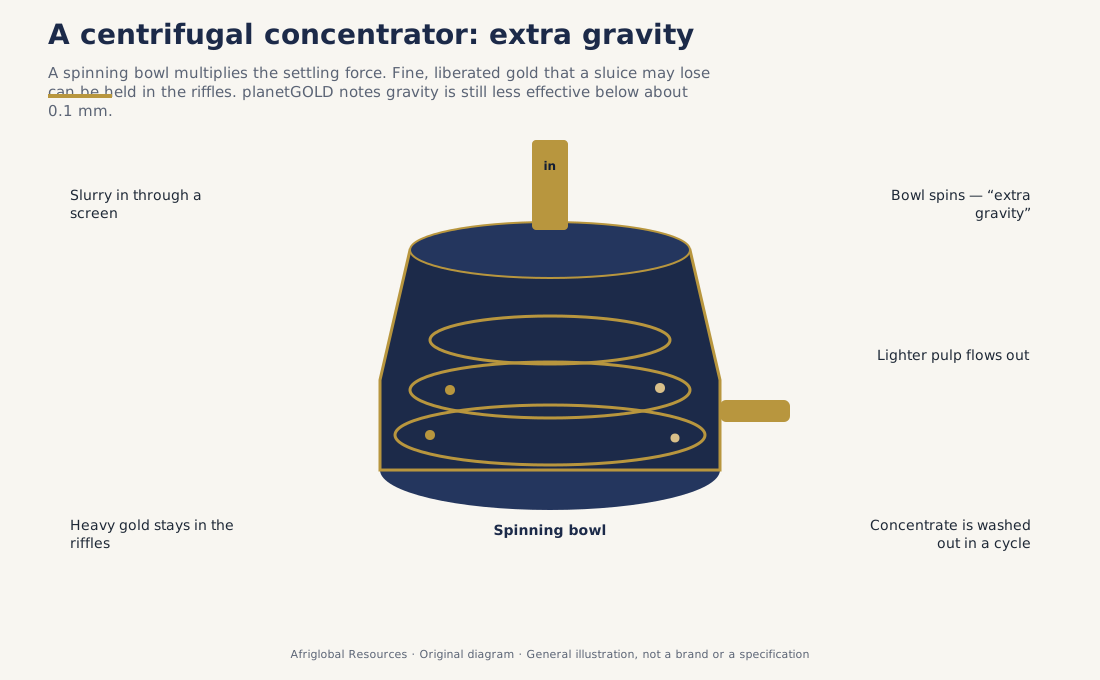
Think of a salad spinner that multiplies gravity. A spinning bowl helps hold finer, liberated gold that a sluice may lose. It still cannot catch gold that is locked in rock, or gold that is extremely fine.
Centrifugal concentrators feed a slurry into a bowl that spins. The extra settling force holds heavy grains in riffles while lighter pulp flows out. The concentrate is washed out in cycles. These machines need power, water and regular, competent operation. planetGOLD’s Equipment for Responsible Mining booklet describes certain concentrators, in that booklet’s context, as processing about 1–3 tonnes per hour and recovering between 70 and 85% of the gold present in the material. That is a figure from a booklet, not a guarantee for your ore or your machine.
5. Shaking tables
In brief
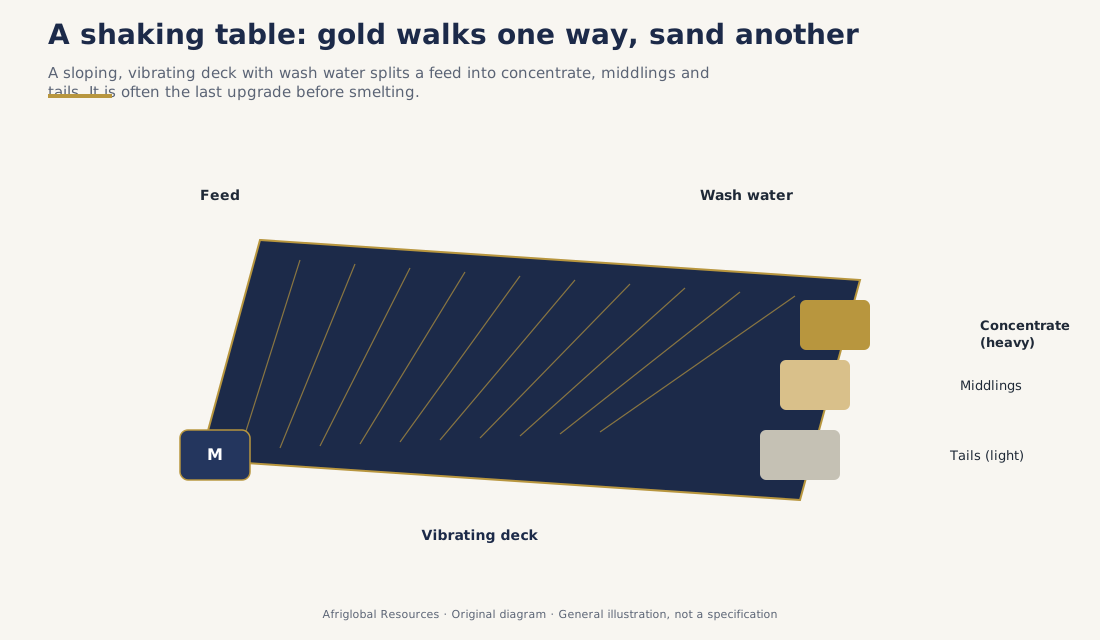
Think of a shaking hillside. Heavy grains walk one way; light sand is washed another. A table is often the last upgrade before a concentrate is rich enough to smelt.
A shaking table is a sloping, vibrating deck with a film of wash water. Feed is spread onto the deck; the motion and the water split it into a heavy concentrate, middlings and tails. Tables need a fairly level site, even feed and power. They are usually a finishing tool, not a substitute for crushing, and they will not rewrite a poorly liberated ore. Used after a sluice or a centrifuge, they are one of the cleanest ways to prepare a small mass of concentrate for direct smelting — the step that, in many mercury-free circuits, replaces the amalgam.
6. Direct smelting with a flux such as borax
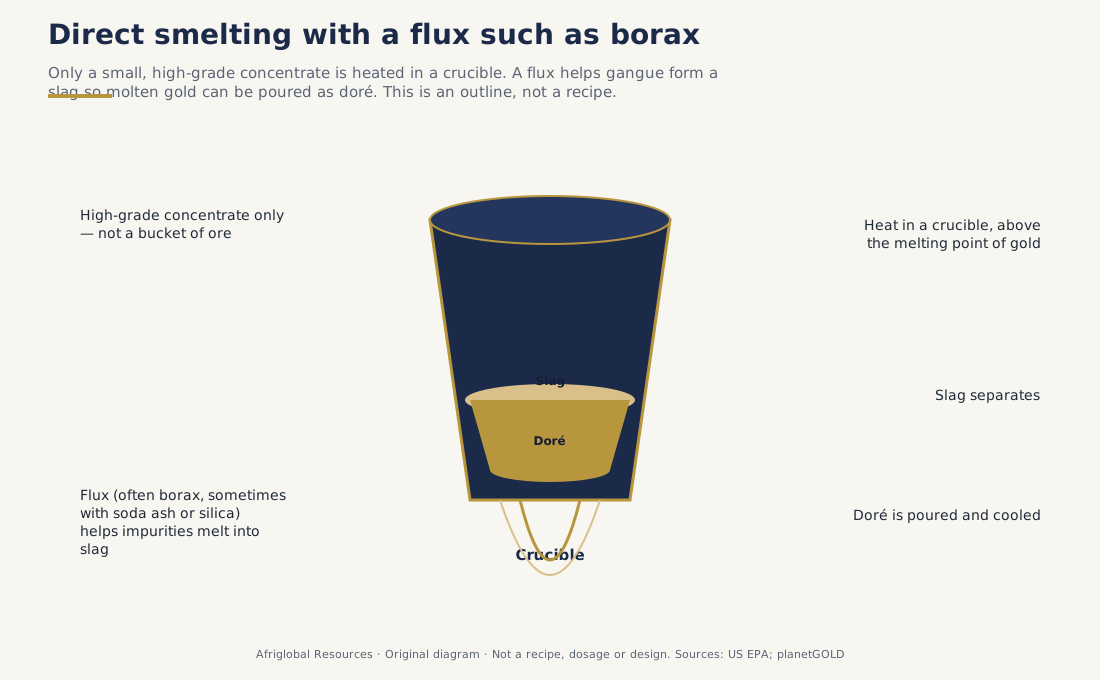
Once a concentrate is rich, you no longer need a chemical magnet. You need heat. In direct smelting, a small mass of high-grade concentrate is placed in a crucible with a flux — often borax (sodium tetraborate), sometimes with soda ash, silica or lime — and heated until the gold melts. The flux helps non-gold minerals melt into a slag, so the gold can be poured and cooled as doré.
The US EPA’s guide to artisanal and small-scale gold mining without mercury, and planetGOLD technology notes, make a point that is easy to miss: this is not a drop-in replacement applied at the same stage as mercury. Mercury is often added to a relatively large, still-dirty concentrate. Direct smelting is performed on a small, already upgraded mass. The EPA notes that miners typically smelt on the order of tens to about a hundred grams of concentrate, and that gold melts at about 1,065°C. Those are orientation figures, not a recipe for your ore, your fuel or your crucible. This article does not give mix ratios or firing instructions.
Going deeper
UNEP and UNIDO guidance has also stressed that “the borax method” is a slightly misleading name. The skill that matters most is better concentration — milling, sluicing, centrifuging and tabling — so that only a rich, small charge goes to the fire. A flux cannot rescue a bucket of raw sand.
7. A cautious word on small-scale cyanidation
Some gold will not report to a sluice or a table, even after careful liberation — because it is very fine, or still locked, or locked in sulphides. In that case a leach may be considered. It is a different tool, with a different legal and technical burden. Our guide to CIP vs vat leaching in Tanzania — and when gravity is enough sets out the difference between a still vat, a stirred CIP plant and a heap, and why test work comes first.
Cyanide is a controlled industrial chemical, not a camp shortcut. In Tanzania, chemical use is regulated through the Government Chemist Laboratory Authority (GCLA). Environmental approvals sit with the National Environment Management Council (NEMC). The mineral right and processing are matters for the Mining Commission. A leach circuit is unfinished without a planned route for residual cyanide, solution control and tailings. This article does not give doses, recipes or a “small-scale cyanide kit.”
Never apply cyanide to material that still contains mercury. That combination is one of the worst practices named in Annex C of the Minamata Convention: cyanide can mobilise mercury and make the pollution worse. If tails or old dumps may have been amalgamated in the past, they need competent assessment and mercury removal before any leach is even discussed.
8. Chemical alternatives, only where sourced
Mining camps sometimes sell bottles and powders as “medicine for gold.” This article will not recommend them. Unless a method is described by a competent authority, with clear chemistry, licences and waste handling, it is not an alternative — it is a risk.
The sourced chemical route discussed here is licensed cyanidation, set out more fully in our CIP vs vat guide, and only on mercury-free feed. Fluxes used in direct smelting (borax and related salts) are not lixiviants: they are melting aids for a rich concentrate, described in outline by the US EPA and planetGOLD. Other lixiviants appear in the technical literature; they are not household methods and are not described here. If a vendor cannot show you a source, a licence path and a plan for the residue, walk away.
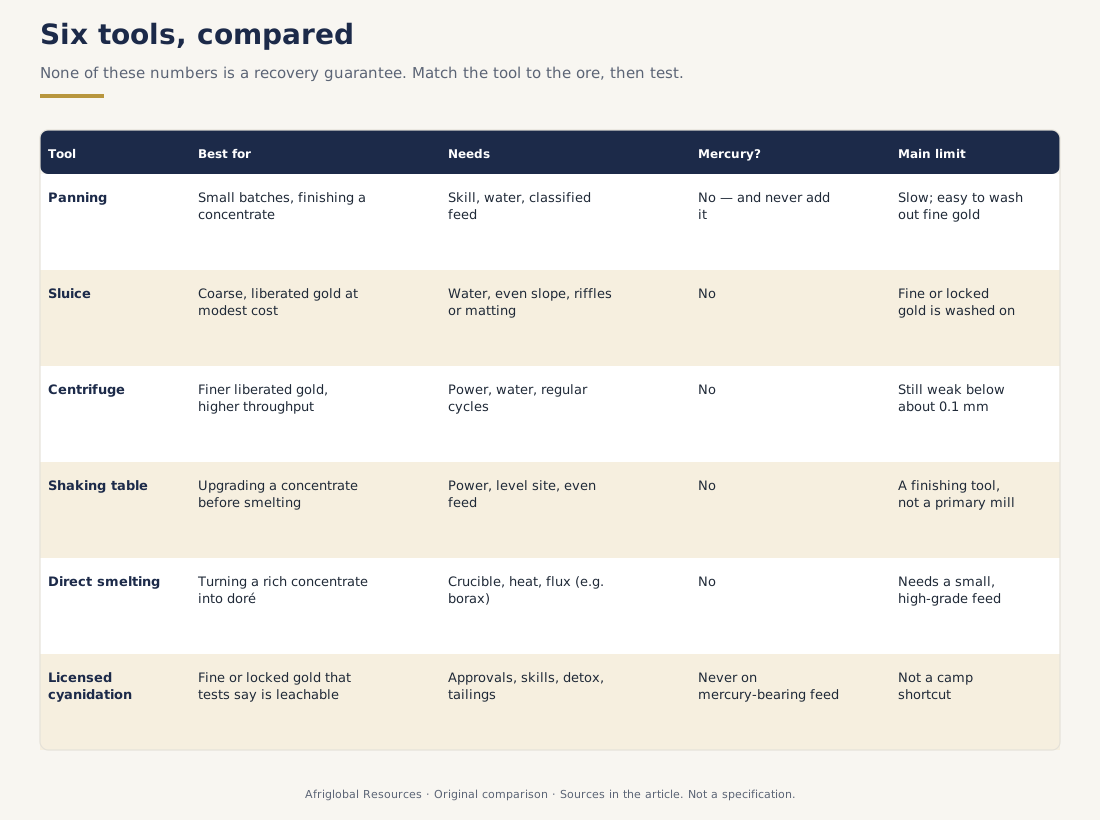
9. Comparing the tools
10. Which mercury-free route fits the ore?
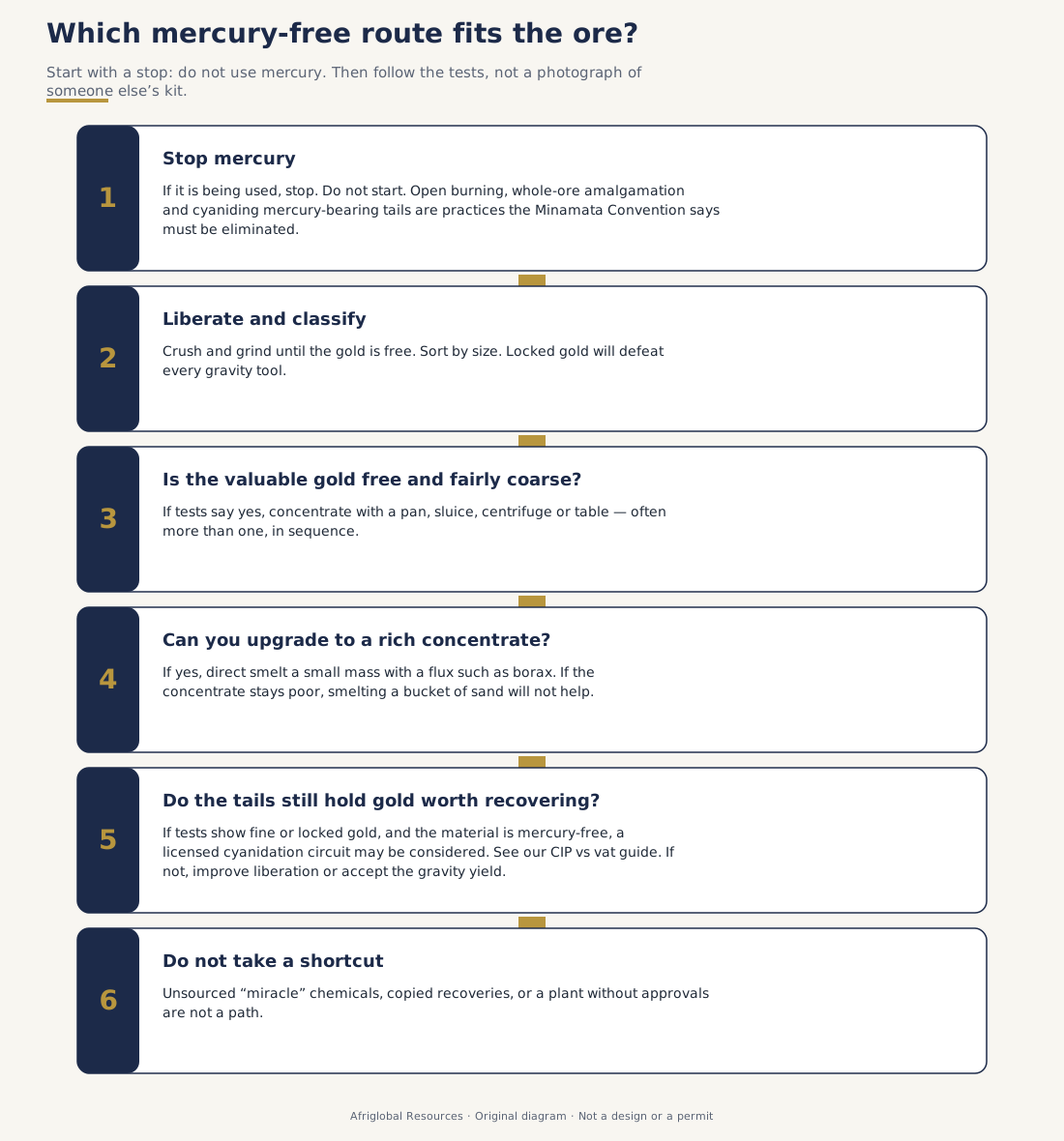
11. A worked example (illustrative numbers only)
These numbers are assumed so you can follow the arithmetic. They are not assays from Kitete or Umoja, and they are not a forecast for any Afriglobal plant.
Suppose a small team treats 1 tonne of already-crushed ore in a day, at an assumed head grade of 3 grams of gold per tonne.
Gold in that day’s feed = 1 × 3 = 3 g.
Suppose a gravity test on this illustrative, well-liberated, fairly coarse ore recovered 70% — a figure in the same range as some concentrator examples in planetGOLD’s equipment booklet, used here only so the arithmetic is visible, not as a promise. Gravity product = 2.1 g. Gold remaining in the tails = 0.9 g.
Suppose the concentrate is then upgraded and direct-smelted, with an assumed further 5% handling loss on that 2.1 g. Doré gold in the example ≈ 2.0 g.
The 0.9 g left in the tails is a test question, not a reason to add mercury. If the gold is very fine or still locked, a longer sluice will not invent it. A leach is a separate, licensed decision, and only if the tails contain no mercury. If the same team had skipped proper crushing and classification, a much lower gravity yield would have left more gold behind — and that shortfall is often what tempts people back to amalgam. The lesson of the arithmetic is to invest in liberation and upgrading, not in a poison.
Common mistakes
- Adding mercury to a pan, a sluice or a mill. Whole-ore amalgamation is a named worst practice. So is “just a little” in the pan.
- Burning amalgam in the open, in a house, or at a trading stall. The vapour does not stay in the bowl.
- Treating a retort or a “capture lid” as mercury-free. Capturing some vapour is not the same as stopping the use of mercury.
- Cyaniding old tails that may still contain mercury, or buying a leach kit with no GCLA, NEMC or Mining Commission path.
- Trying to smelt a bucket of low-grade sand. Direct smelting needs a small, high-grade concentrate.
- Expecting a sluice or a centrifuge to catch gold that is still locked, or copying a 70–85% booklet figure as if it were your assay.
- Buying unsourced “miracle” chemicals with no chemistry, no licence and no plan for the residue.
Safety and the environment, in brief
Do not use mercury. If mercury has been used on a site in the past, treat tools, yards, ponds and tails as potentially contaminated. Keep children and pregnant women away from processing areas. Do not burn, sweep or casually reprocess old amalgam residues.
Vapour and fish are both routes of harm. WHO guidance is clear that inhaled elemental mercury and ingested methylmercury damage the nervous system and other organs. A clean-looking workshop can still be a source of exposure.
Direct smelting is heat, not a toy. Crucibles, fuel and molten metal need eye protection, distance, and a plan for hot slag. Flux fumes are not harmless. This is not a recipe — it is a reason to learn the work from competent trainers, not from a photograph.
Cyanide is a licensed industrial chemical. Approvals run through GCLA, NEMC and the Mining Commission. Never apply it to mercury-bearing feed. Residue, detox and tailings are part of the process, not an afterthought. See our CIP vs vat leaching guide.
What this means
- For small-scale miners and PML holders: start with better crushing, classification and mercury-free gravity. Upgrade a concentrate until it can be smelted. Do not use mercury, and do not leach material that may contain it.
- For investors: a mercury-free circuit is not a slogan. It is liberation, test work, and — only where the ore and the licences support it — a formal leach. Afriglobal’s current processing route at Umoja is vat leaching; a 200 tonnes-per-day CIP plant is a proposal, not current capacity.
- For students and the public: mercury “works” because it alloys with gold. It is being stopped because of what happens next — to lungs, to children, to fish and to rivers.
Quick tip: if you sell gold, check the day’s official price on our Mining Commission prices page, and see our explainer on how gold goes from ore to bar in Tanzania.
Key takeaways
- Gold does not need mercury. Mercury alloys with gold — then becomes vapour and a lasting environmental poison.
- Tanzania is a Party to the Minamata Convention (ratified 5 October 2020; in force 3 January 2021). The 2020–2025 National Action Plan aims to reduce, and where feasible eliminate, mercury in ASGM.
- Liberate, classify, then concentrate by density: pan, sluice, centrifuge, shaking table.
- Direct smelting with a flux such as borax works on a small, high-grade concentrate, not a bucket of raw ore. This article is not a recipe.
- Cyanidation is a licensed industrial step, never to be used on mercury-bearing feed. See our CIP vs vat guide.
Glossary
| English | Kiswahili | In this article |
|---|---|---|
| Mercury | Zebaki | A metal that is liquid at ordinary temperatures and alloys with gold; toxic as vapour and as methylmercury. |
| Amalgam | Amalgam | The alloy formed when mercury wets and combines with gold. |
| Whole-ore amalgamation | Kuunganisha mawe yote kwa zebaki | Adding mercury to a large mass of ore with little prior concentration — a Minamata worst practice. |
| Open burning | Kuchoma wazi | Heating amalgam in the open so mercury vapour is released — a Minamata worst practice. |
| Methylmercury | Methylmercury | An organic form of mercury, made by microbes in water and soil, that builds up in fish and people. |
| Gravity concentration | Utenganishaji kwa uzito | Separating liberated gold by density, without mercury. |
| Sluice | Sluice (mfereji wa kuchujia) | A sloping channel with riffles or matting in which heavy gold can settle. |
| Centrifugal concentrator | Mashine ya mzunguko | A spinning bowl that multiplies settling force to hold finer liberated gold. |
| Shaking table | Meza inayotikiswa | A vibrating, sloping deck used to upgrade a concentrate before smelting. |
| Direct smelting | Kuyeyusha moja kwa moja | Melting a small, high-grade concentrate with a flux, without mercury, to pour doré. |
| Flux (e.g. borax) | Flux (k.m. borax) | A melting aid that helps gangue form a slag so gold can separate. Not a recipe in this article. |
| Doré | Doré | A partly impure gold–silver bar, smelted on site, later refined to bullion. |
| Minamata Convention | Mkataba wa Minamata | The global treaty on mercury. Tanzania is a Party. Annex C lists ASGM practices to eliminate. |
Check what you have learned
Five questions. Choose one answer each, then check. This is a self-test, not a certificate.
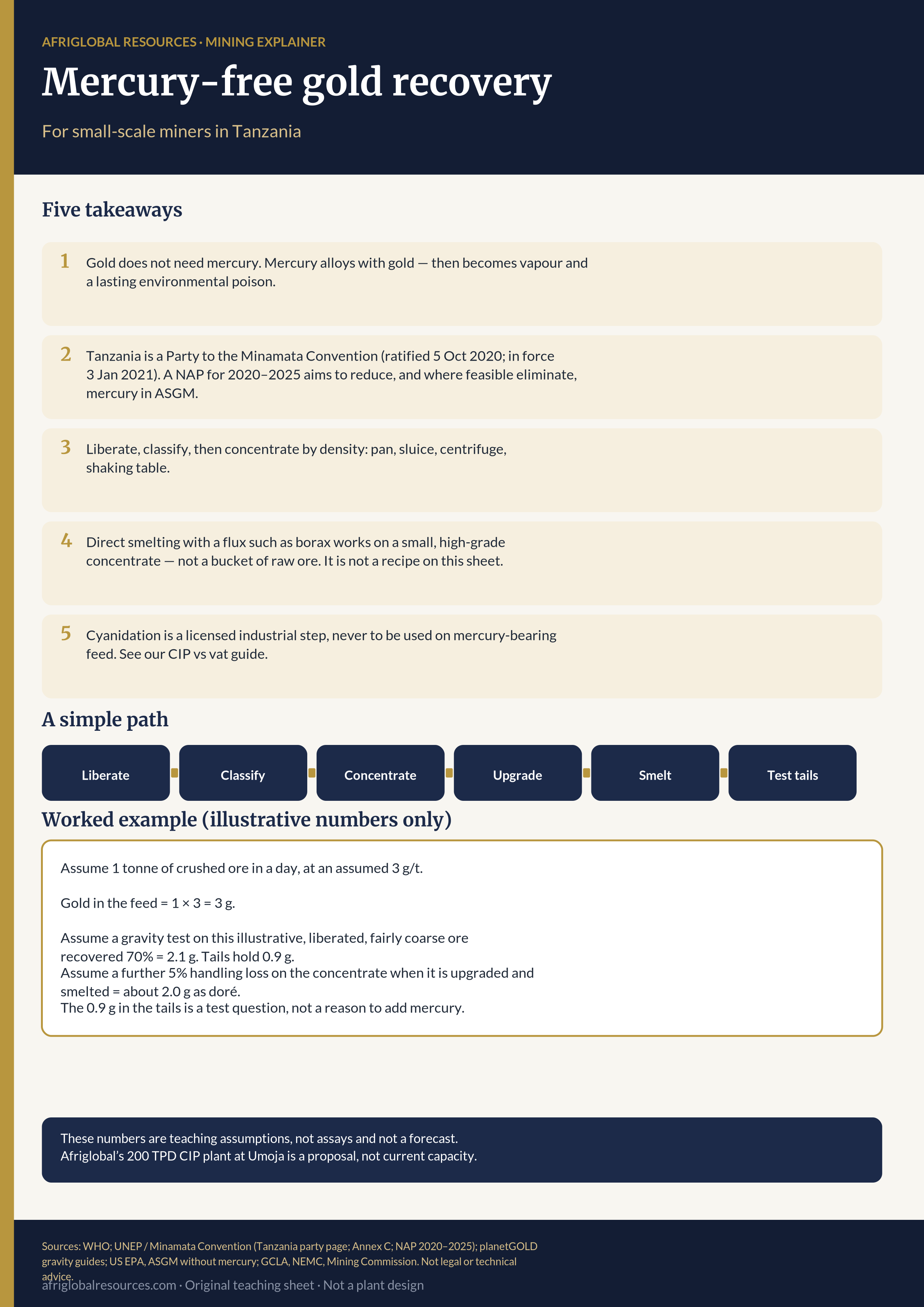
One-page summary
A single printable sheet: the five takeaways, the mercury-free path, the worked example and the main sources. Useful for a classroom, a site office or a briefing pack.
Looking ahead in Tanzania
The direction of travel is already written into law. Tanzania is a Party to the Minamata Convention. The future of small-scale gold is mercury-free: better crushing, better classification, gravity circuits that actually match the ore, and — only where tests and licences support it — carefully managed cyanide plants. The other half of that future is data. A photograph of a concentrator is not evidence. Assays, liberation tests and a clear account of the tails are. The miners and buyers who insist on those numbers will take more gold home and leave less poison behind.
That is also how Afriglobal intends to think about Chunya: run the vats that are already there, keep mercury out of the circuit, and treat a larger plant as something you earn with tests, financing and approvals.
Afriglobal Resources in Chunya
At Kitete, existing underground shafts are the main ore source of the Chunya–Makongorosi project. At Umoja (Makongorosi), there is an existing vat-leach facility and the proposed site of a 200 TPD CIP processing plant: a proposed first-phase development, not current capacity; subject to financing, an independent Competent Person review, exploration drilling, assays and QA/QC (all still to be completed), and approvals. Project financing for this phase is being sought.
Read more on our projects page, or our explainers on CIP vs vat leaching, processing gold from ore to bar and mining licences in Tanzania. Contact us to arrange a site visit.
Kwa Kiswahili (makala kamili)
Toleo kamili la makala hii — si muhtasari tu — lipo kwa Kiswahili: Kurejesha dhahabu bila zebaki kwa wachimbaji wadogo Tanzania.
Sources: WHO, Mercury and health; WHO, Mercury exposure and health impacts in ASGM; Minamata Convention, United Republic of Tanzania (signature 10 October 2013; ratification 5 October 2020; entry into force 3 January 2021); Minamata Convention text, Annex C; United Republic of Tanzania, National Action Plan for Artisanal and Small-Scale Gold Mining 2020–2025; Tanzania, first full Minamata national report (2021) (including cooperation with the World Bank on the Environmental Health and Pollution Management Project); planetGOLD, Practical Guide: Gravimetric Plants for Mercury-Free Gold Recovery (including the note that gravity is less effective below about 0.1 mm); planetGOLD, Equipment for Responsible Mining (example concentrator recoveries of 70–85% in that booklet’s context); US EPA, Artisanal and Small-Scale Gold Mining Without Mercury (gravity tools and direct smelting in outline); UNEP/UNIDO practical guidance on direct smelting and concentration. Site facts about Kitete, the Umoja vat-leach facility and the proposed 200 TPD CIP plant are as stated on our projects page. Chemical and environmental licences are matters for the GCLA, NEMC and the Mining Commission. This article is general information, not legal or technical advice; check current rules with those authorities, and base any plant decision on site-specific test work and approved design.
Questions about investing in Tanzanian gold?
Talk to our team about our projects in Chunya and Handeni, or arrange a site visit.